
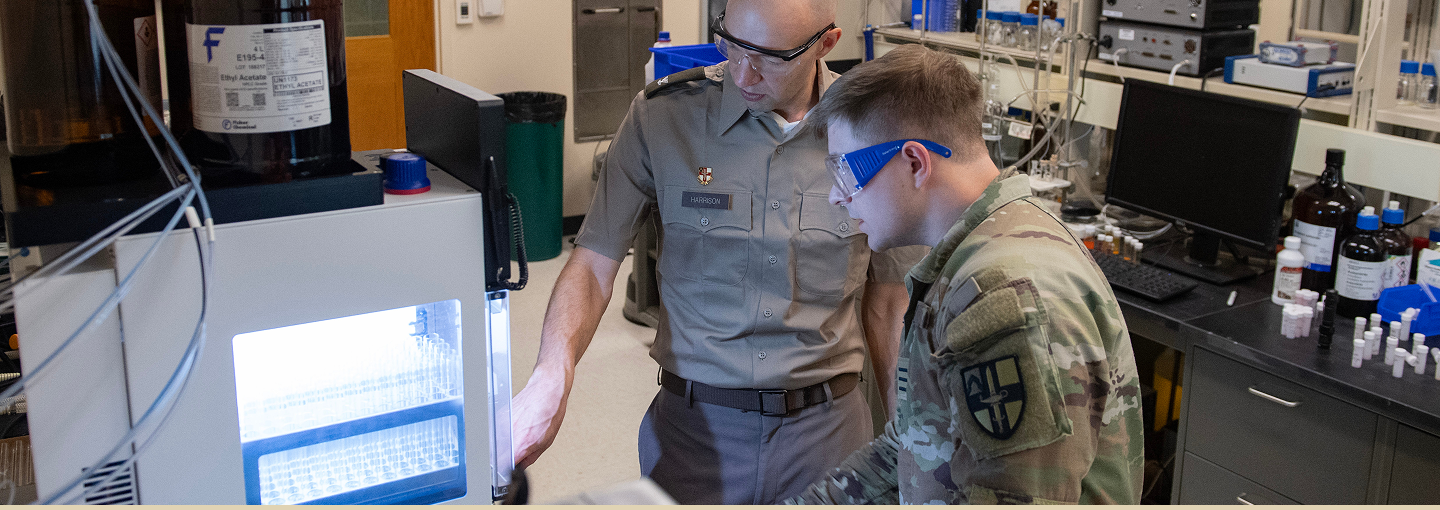

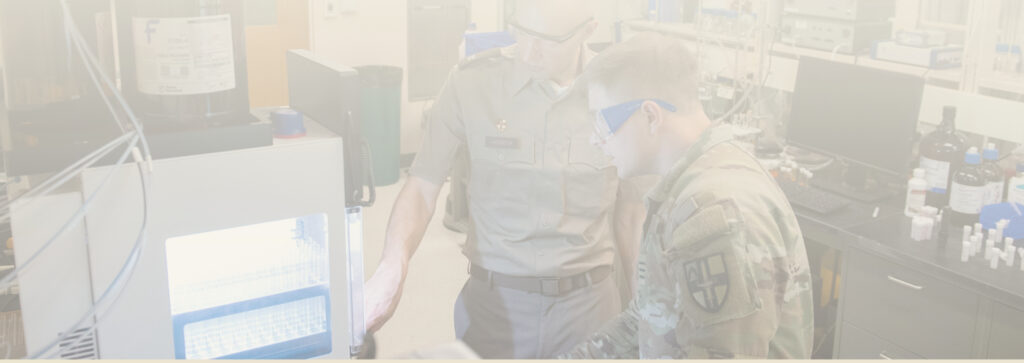
Maury-Brooke Hall — the home of VMI’s Department of Chemistry —The VMI Chemistry department is dedicated to ensuring that cadets get hands-on experience with the critical tools that drive modern science.
Cadets, starting in their 4th class year, are immersed in integrated projects that utilize nuclear magnetic resonance spectroscopy, computational methods, chromatography, and other modern techniques — instruments and methods that are typically reserved for upper level or graduate students at larger universities. Through our innovative computational and instrumental methods across the curriculum initiative, cadets learn essential skills and gain the confidence and experience necessary to undertake independent research early in their career.
The department features a diverse range of instrumentation and maintains a server for advanced computational analysis.
Topic-Specific Equipment on Post
Computational Scientific Tools


Tools that rely on high performance computing (HPC) to run detailed simulations on systems of interest, are revolutionizing not only chemistry, but almost every scientific discipline. To support both faculty with research interests in computational science and cadet training, the VMI chemistry department maintains its own HPC system. This resource allows cadets and faculty to conduct research quality calculations on a scale that otherwise require remote supercomputer access.
Dell HPC workstation — Equipped with state-of-the-art software quantum software packages, 2 Intel Xeon Platinum 8569Y+ processors, and 512 GB of RAM.
Molecular Spectroscopy
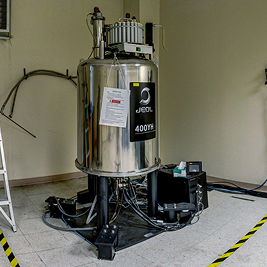
Nuclear Magnetic Resonance (NMR) Spectroscopy — A critical instrument for determining molecular structure and dynamics by exploiting the magnetic properties of atomic nuclei.
- JEOL 400YH Resonance ECZ 400s — A high-resolution, multi-element instrument used for advanced research in material science, pharmacology, and catalyst design.
UV-Visible Spectroscopy — Measures how substances absorb light in the UV and visible range to determine concentration and chemical properties.
- Varian Cary 5000 UV-Vis-NIR Spectrometer — A research-grade instrument with exceptional resolution used for advanced chemical and materials studies.
- Six Ocean Insight Flame-Chem-UV-Vis Spectrometer with QP-400-2-SR Fiber Optic Probe – Compact, portable spectrometers capable of both transmissions and absorption measurements used for both research and teaching applications.
- Thermo LabSystems Multiscan UV-Visible Spectrometer with Plate Reader — Designed for high-throughput biochemical analysis.
- Ocean Optics USB2000 with Reflectance Probe — A compact, portable spectrometer used to measure surface reflectance for materials and environmental testing.
- Agilent 8453 UV-Vis Photodiode Array Spectrophotometer with temperature control unit— A fast single-beam, full spectra spectrophotometer ideal for kinetic analysis and equilibrium studies.
- Magnitude Instruments enVISTA Transient Absorption (TA) Spectrometer – a state-of-the-art, benchtop instrument that analyzes molecular excited states with nanosecond resolution. Provides R1-level technology exposure to VMI cadets.
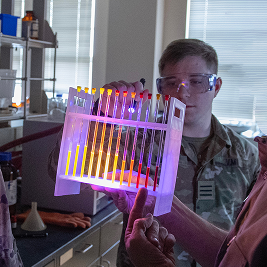
Fluorescence Spectroscopy — A highly sensitive analytical technique that analyzes light emission from molecules often used in biochemistry, material science, and forensics.
- Varian Cary Eclipse Fluorescence Spectrophotometer — A highly sensitive system ideal for research involving trace-level detection.
- Thermo LabSystems Fluoroscan Ascent Fluorometer with Incubator — Useful for biological or temperature-sensitive samples that need controlled conditions.
Infrared (IR) Spectroscopy — Examines how molecules absorb infrared light to identify chemical bonds and structures in liquid, solid, and gas samples.
- Thermoscientific Nicolet iS20 FT-IR with Smart iTX
- Shimadzu IRAffinity-1 FT-IR with ATR
Raman Spectroscopy — Uses laser light to study molecular vibrations when IR spectroscopy is not applicable..
- Snowy Range Instruments 785 nm Sierra —A portable Raman tool ideal for analyzing solids, minerals, and materials.
Atomic Spectroscopy
Detects trace metals in chemical samples by measuring their absorption and emission properties. Facilitates elemental qualitative and quantitative analysis in environmental, material, and forensic applications.
- GBC Avanta Atomic Absorption Spectrometer.
Mass Spectometry
Identifies chemicals by ionizing molecules and measuring the mass of the ion and associated fragments. A critical tool for the development of new compounds.
- Shimadzu QP-2020 Gas Chromatograph–Mass Spectrometer — Facilitates the rapid separation of complex mixtures by gas chromatography and molecular identification of these components.
Chromatography
Techniques that facilitate the separation and analysis of complex mixtures based on their interactions between mobile and stationary phases or electrophoretic mobility.
Gas Chromatography (GC) — Used for resolving volatile compounds such as solvents and organic chemicals using a gas based mobile phase.
- TwoShimadzu GC-8 Systems (dual columns, TCD detectors) — Reliable units for student training and general-purpose chemical analysis.
- Shimadzu GC 2014 Capillary Column GC with FID Detector — Offers high sensitivity for organic compounds, commonly used in environmental, archaeological and biofuel testing.
Liquid Chromatography (LC) — Used for separating non-volatile compounds through use of a liquid mobile phase.
- Shimadzu LC-2050 Liquid Chromatography system with UV-VIS detection –
- Buchi Pure C-810 Flash-UV Chromatography System – Flash chromatography enables small to large scale sample purification of complex mixtures.
- Teledyne ISCO CombiFlash Rf 200 Flash-UV Chromatography System – provides a second system for the fast and efficient separation of complex mixtures.
Capillary Electrophoresis (CE) — Used for separating non-volatile compounds through the use of high voltages. Molecules separate within the field as a function of size and charge.
- Agilent 7100 Diode Array Capillary Electrophoresis System
Electrochemical Analysis
Studies chemical reactions by measuring electrical signals.
- Pine WaveDriver 20 Bipotentiostat with Rotating Ring Disk Electrode — Allows advanced studies of reaction mechanisms and electron transfer processes.
- WaveDriver 20 Bipotentiostat/Galvanostat System — Supports a wide range of electrochemical experiments for student and faculty research.
- BASi Epsilon Electrochemical Workstation — A user-friendly system ideal for teaching voltammetry and other core electrochemical techniques.
Optical Microscopy
Provides close-up imaging of samples too small to see with the naked eye.
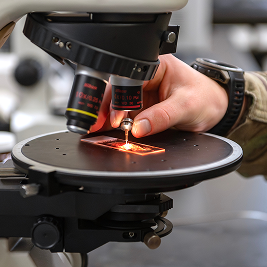
- Nikon Eclipse 50i POL Polarizing Microscope — Used for studying crystals, minerals, and anisotropic materials.
- Nikon C-DS Diascope Zoom Stereo Photo Microscope — Offers 3D viewing and photography of specimens—great for labs and documentation.
Thermoanalysis
Measures how materials change with temperature.
- Q20 Modulated Differential Scanning Calorimeter (DSC) — Used to study melting points, glass transitions, and thermal stability of materials.
Synthesis
Tools used to create or purify chemical compounds.
- CEM MARS6-TA Microwave — Speeds up chemical reactions using microwave energy—much faster than traditional heating.
- CEM Discover 2.0 with Autosampler — Speeds up chemical reactions using microwave energy—much faster than traditional heating.
- Anton Paar Monowave 450 Microwave Reactor — Speeds up chemical reactions using microwave energy—much faster than traditional heating.
- Luzechem LZC-L16 Photoreactor — Initiates chemical reactions efficiently using light, oftentimes allowing reactions that are inaccessible by traditional means to occur.
- BioRad BioLogic DuoFlow 10 System with BioFrac Fraction Collector — Purifies proteins and other biomolecules by separating them into fractions.
- Teledyne CombiFlash Rf-200 Automated Flash Chromatography System — Purifies synthesized compounds quickly and efficiently.
- Buchi Pure C-810 Flash-UV Chromatography System — Purifies synthesized compounds quickly and efficiently.
- Thermo Scientific Sorvall Legend XTR Refrigerated Centrifuge — Spins samples at high speeds to separate solids, liquids, or materials based on density.
- Vacuum Atmospheres Co. Controlled Atmosphere Systems Drybox — Allows chemists to work with air-sensitive materials safely in an oxygen-free environment.
X-Ray Spectroscopy
Used to determine the precise 3D structure of crystals and complex molecules.
- Rigaku XtaLAB Mini II Single Crystal X-ray Diffractometer — A professional-grade instrument that lets students and researchers see the atomic structure of molecules with high precision.
Questions? We’re Here to Help
Connect with Chemistry


Email: chemistry@vmi.edu

Phone: (540) 464-7244

Chemistry Office
401 Maury-Brooke Hall