Chemistry Professor Awarded Research Grant
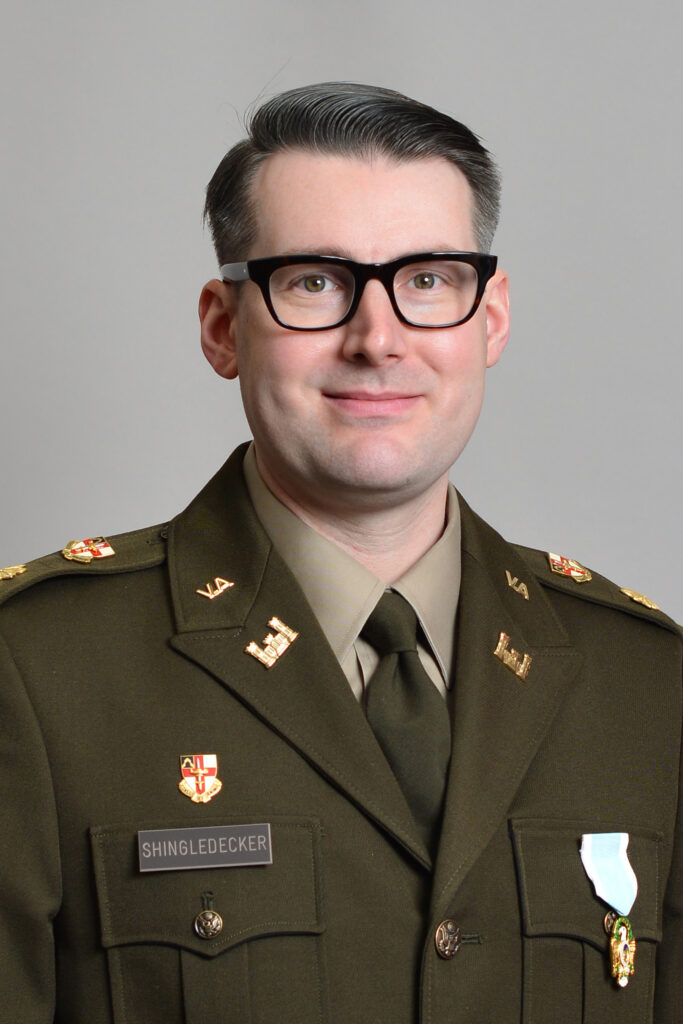
The Camille and Henry Dreyfus Foundation has selected Maj. Christopher N. Shingledecker, assistant professor of chemistry at Virginia Military Institute, as one of eight new Henry Dreyfus Teacher-Scholars for 2026. The award honors young faculty in the chemical sciences who have created an outstanding independent body of scholarship and are deeply committed to education with undergraduates. Each Henry Dreyfus Teacher-Scholar receives an unrestricted research grant of $75,000.
The purpose of the foundation is to advance the science of chemistry, chemical engineering, and related sciences as a means of improving human relations and circumstances throughout the world. Established in 1946 by chemist, inventor, and businessman Camille Dreyfus as a memorial to his brother Henry, the foundation became a memorial to both men when Camille died in 1956. Throughout its history the foundation has sought to take the lead in identifying and addressing needs and opportunities in the chemical sciences through a series of programs and awards.
Shingledecker was awarded for his research proposal, “A Theoretical Investigation of Stardust: The Mysterious Catalyst of Chemical Complexity in the Universe,” in which he argues that stardust is the secret ingredient for much of the chemistry in the universe. “It’s on the surfaces of stardust where a wide range of molecules form in space, such as molecular hydrogen, the most abundant molecules in the universe. Another interesting connection is that, based on chemical analysis of material from meteorites and asteroids, we know that the molecular building blocks of life, such as amino acids and nucleobases, somehow form in space. Though the exact chemistry is not known, stardust is almost certainly where these molecules form,” he explained. Finally, he noted, “Beyond molecule formation, stardust plays a critical role in the very formation of stars and solar systems where life—including chemists who can ask questions about stardust—can exist!”
Shingledecker’s research to better understand the chemical role of stardust in the universe will include developing equations that can better be used to calculate the chemistry that occurs on stardust, and in the icy coatings that stardust grains acquire in star-forming nebulae; drilling down on the chemical contribution of sulfur on stardust grains; and modeling the spectra of the molecules trapped in those icy stardust grain coatings. “The James Webb Space Telescope was designed in part to provide the best-ever view of these icy spectral fingerprints, but to date, there is not a good way to simulate them with computers. My goal is to develop the first such model that can do this fairly well,” he said. VMI cadets will be involved with every aspect of this work by writing code, running simulations, analyzing data, and comparing it with astronomical observations.
The funds will support five years of work on the projects, and will cover a wide range of costs associated with Shingledecker’s research and teaching activity, including materials for classes, research equipment, and computing time on major supercomputers. The award will also be used to support travel by Shingledecker and his cadet-researchers to international conferences where their results can be shared with the broader scientific community, as well as costs related to the publication of the results in top peer-reviewed journals.