
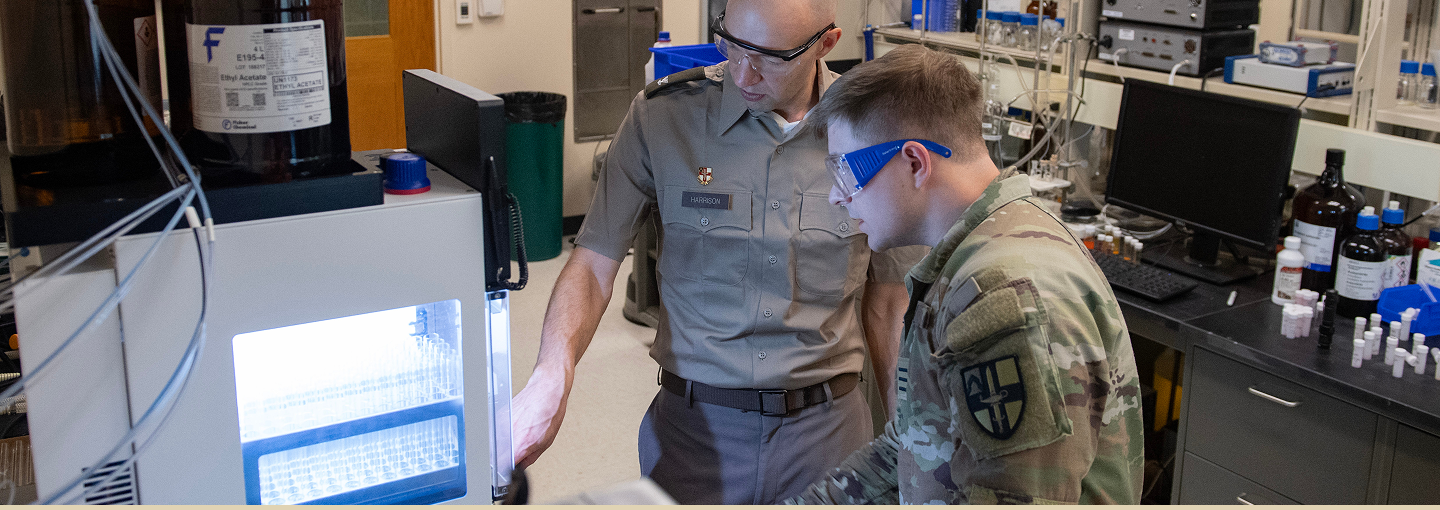

A chemistry degree from VMI opens doors across industry, government, the military, medical schools, and graduate studies.
A chemistry degree builds rigorous skills in analysis, problem-solving, and experimentation that translate into high-impact careers. Whether you see yourself innovating in a lab, improving manufacturing processes, protecting the environment, or teaching future scientists, chemistry offers a broad spectrum of opportunities. Use this guide to explore roles, industries, job strategies, and trends so you can move from coursework to a meaningful career with confidence. Throughout, you will find concrete examples of careers for chemistry majors, the most compelling jobs for chemistry majors, and how to align your goals with a purposeful career trajectory.
Graduate Outcomes for 2016-2025
Out of 82 graduates:
- 64% — Commissioned into domestic and foreign militaries
- 21% — Industry
- 12% — Medical/Dental/Pharmacy School
- 8% — Graduate/professional school
Exploring Career Avenues For Chemistry Graduates
Research and Development (R&D)
Common titles include research chemist, analytical chemist, materials scientist, and polymer chemist. The work involves designing experiments, running instruments like HPLC, GC-MS, and NMR, and collaborating with engineering teams on projects ranging from designing new battery materials to catalysts and sustainable coatings. R&D roles exist in corporate labs, federal agencies, and national laboratories.
Process And Scale-Up
Process chemists, process development scientists, and manufacturing scientists translate bench reactions into production-scale operations — optimizing yield, reducing waste, and meeting safety and quality standards. Strength in unit operations, reaction kinetics, and statistical process control is valuable, and a Six Sigma credential is a common career accelerator.
Pharmaceuticals and Biotechnology
Pharmaceuticals and Biotechnology: Pharma and biotech employ chemists in medicinal chemistry, analytical development, formulation, QC/QA, and regulatory affairs — synthesizing candidate compounds, developing analytical methods, and supporting FDA compliance. Related paths include clinical laboratory technology and toxicology, which apply chemical analysis to diagnostics and public-health work.
Resources for Your Career Journey
Professional Organizations
The American Chemical Society (ACS) offers student memberships, career workshops, and a job board, with local chapters hosting networking events. Process-focused students should also look at the American Institute of Chemical Engineers (AIChE), and those interested in lab automation at the Society for Laboratory Automation and Screening (SLAS).
Job Boards and Career Tools
ACS Careers and ChemIDP are the field-specific starting points; BioSpace and Materials Today Jobs cover biotech and materials roles. Cadets should also use Handshake and the career fairs run by VMI’s Office of Career Services.
Continuing Education
Consider microcredentials in areas like GMP/GLP compliance, chromatographic method development, and data analysis. Certifications such as ASQ Six Sigma or Regulatory Affairs Certification (RAC) build leadership skills. Graduate programs in chemistry or related fields offer advanced career opportunities.
Frequently Asked Questions
At VMI, all scholarships share one goal: expanding access to an education that develops honorable, purposeful, and capable citizen-soldiers. Scholarships typically do not require repayment—as long as you remain in good standing—and may be based on merit, need, leadership, athletics, service, or specific talents.
Can I major in chemistry while in ROTC at VMI?


Yes — every cadet at VMI participates in ROTC, and chemistry majors commission across all four services. The chemistry curriculum is structured so cadets can complete the major, ROTC requirements, and corps obligations in four years. Faculty advisors work with cadets to sequence demanding courses (organic, p-chem) around field training and summer commitments.
How does VMI prepare chemistry majors for medical school?
The Biochemistry/Pre-Medical track of the B.S. degree is built around medical school prerequisites — two semesters each of general chemistry, organic chemistry, and physics, plus biochemistry, calculus, and biology coursework available through the biology department. Pre-med cadets work closely with faculty advisors on MCAT preparation, application timing, and securing the clinical and research experience medical schools expect.
What technical skills are most sought after by employers?
Employers value experience with chromatography, mass spectrometry, spectroscopy, method development, and data analysis. Programming knowledge and familiarity with electronic lab notebooks enhance competitiveness.
Do chemistry majors have time for the Corps of Cadets?
Yes — chemistry is one of VMI’s most demanding majors, but the schedule is built to accommodate corps duties, athletic commitments, and ROTC training. Lab sessions are scheduled in afternoon blocks that work around morning formations and class periods. Cadets routinely balance the major with varsity athletics, club leadership, and ranked positions in the corps; faculty advisors help map out a four-year sequence that fits each cadet’s commitments.
Want To Learn More About Potential Career Opportunities For Your Major?
Want to learn more about potential career opportunities for your major? “What You Can Do with a Major In…?,” brought to you by the VMI Office of Career Services, provides an overview of a
variety of occupation options. Enroll today in FOCUS 2 using the access code “keydet” to sign-up and start to explore your options after VMI.
Here are some examples of occupations that may interest you:
| Occupation | US National Mean Salary |
|---|---|
| Biochemist | $94,340 |
| Biophysicist | $94,340 |
| Chemist | $80,820 |
| Conservation Scientist | $69,290 |
| Forensic Science Technician | $60,690 |
| Technical & Scientific Publications Editor | $66,080 |
| Technical Publications Writer | $73,160 |
| Toxicologist | $95,000 |
Questions? We’re Here to Help
Connect with Chemistry


Email: chemistry@vmi.edu

Phone: (540) 464-7244

Chemistry Office
401 Maury-Brooke Hall