Steamboat Institute Debate Held at VMI
First Stop in Fall Tour
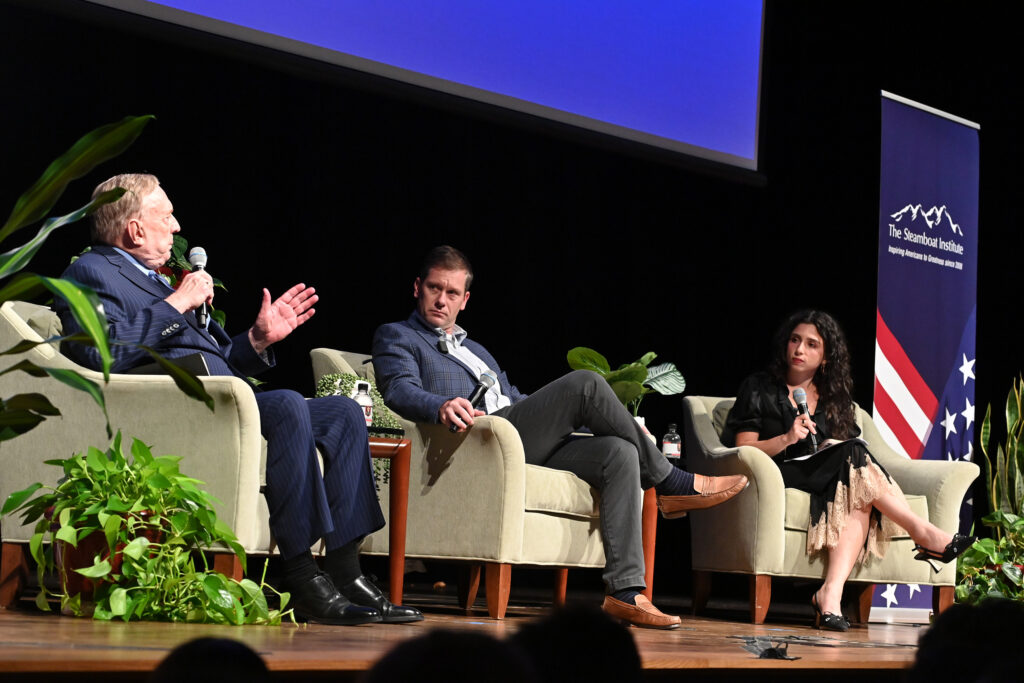
Virginia Military Institute’s Center for Leadership and Ethics (CLE) co-hosted the Steamboat Institute (SI) Campus Liberty Tour in Gillis Theater Oct. 1, for the first debate of its fall schedule involving multiple college campuses.
The debate was livestreamed for viewers all over the world. The resolution debated was: “America benefits from the end of the rules-based international order.” Arguing the affirmative of the resolution was retired U.S. Army Col. Douglas Macgregor, Ph.D., a decorated combat veteran, author of five books, and a defense and foreign policy consultant. Arguing the negative was Hal Brands, Ph.D., columnist, author, and the Henry A. Kissinger Distinguished Professor of Global Affairs at the Johns Hopkins School of Advanced International Studies. The debate was moderated by Carine Hajjar, opinion journalist and editorial board member of The Washington Post and a SI fellow.
The CLE’s theme for this academic year is, “American Spirit 2026” as the country continues to celebrate its birth 250 years ago.
Col. David Gray, executive director of the CLE, remarked, “As our country was founded on debate and deliberation by the founding fathers, it is only appropriate to demonstrate how we can continue to debate thoroughly and civilly on issues that deeply affect our country. We are proud to continue this partnership with the Steamboat Institute for a third year.”
According to Daniel Wagner, director of the Campus Liberty Tour, for nearly 20 years SI has worked to promote America’s founding principles and foster a greater appreciation for the freedom Americans enjoy. “One of the most important ways we pursue that mission is through our Campus Liberty Tour, which brings substantive civil debates to college campuses across the country. Our purpose is not to tell students what to think; it is to challenge them to think critically, listen carefully, question assumptions, and decide for themselves. That spirit is at the heart of every Campus Liberty Tour debate,” he said.
Wagner went on to explain what rules-based international order means.
“It generally refers to the system of international laws, institutions, alliances, agreements, and norms that developed largely in the aftermath of World War II. For decades the U.S. played a central role in building, supporting, and, at times, challenging that system. Today, fundamental questions are being asked about whether that order still serves America’s interests and whether it is capable of meeting the challenges of a very different world. One side argues that the existing international order has helped provide stability, strengthen alliances, facilitate economic cooperation, and establish rules that constrain aggression and make relations among nations more predictable. The other side questions whether that system has become outdated or overly constrained, and whether international institutions and longstanding commitments sometimes prevent the U.S. from acting decisively in its own national interest.”
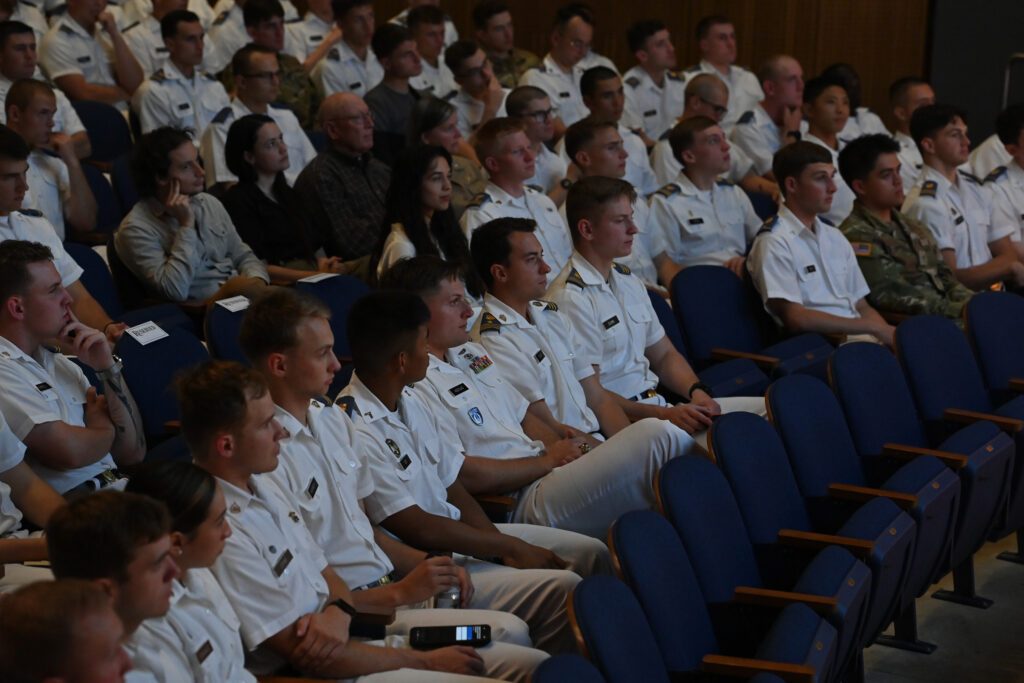
Each debater gave an opening statement, beginning with Macgregor, who asked his audience to consider three points.
“First, international law does not mean that the most powerful country decides what the rules are. After the collapse of the Soviet Union, the U.S. found itself in an extraordinary position. There was no clear competitor, and the strategic question was: What should America do with the power that it has? Second, the liberal international order—the post-Cold War system after 1991—weakened U.S. national security. The order precipitated the rise of new alliances against us. Third, how much American blood and treasure should Americans invest in trying to organize the rest of the world? A big part of the answer, in my judgment, is to stop.”
Macgregor continued to discuss that America is one great power among several, not the government of the world, and that a new role for Washington inside the international system needs to be constructed, based on American national interests and respect for the sovereignty, culture, and interests of others. Additionally, he said, the U.S. does not need to rule the world to be secure, prosperous, or free.
Brands followed Macgregor to the lectern. He stated his definition of the rules-based international order is essentially synonymous with the world order the U.S. built dating back to 1945.
“That world order involves the promotion of certain rules and norms. For example, the idea that there should be freedom of the seas, or the idea that you shouldn’t be able to conquer your neighbor’s territory, the idea that basic human rights should be respected, or that we should have a relatively open world economy that works in relatively predictable ways. That concept of international order has always been rooted in U.S. self-interest and living in a relatively stable, civilized world.” Brands continued by pointing out that this order has been more good than bad for the world, and for the U.S. “International trade and prosperity reached new levels. Democracy and human rights became more widespread than ever before. There have been plenty of bad things that have happened since 1945, but the last 80 years have been about the best in the history of humanity. The U.S. has had tremendous influence as the country that anchors key alliances and sets the terms of the international system.”
He did concede that times change and aspects of the rules-based order need to be updated.
“It’s true the U.S. needs better burden sharing within its alliances, so it’s good that countries in East Asia and Western Europe are spending more on defense. It’s true China exploited its entry into the World Trade Organization to create preferential status, even as it maintained a protectionist economy. So, the U.S. and its friends will have to find ways of pushing back. It’s true certain institutions like the U.N. or World Health Organization have been corrupted by autocratic powers. So, I certainly don’t pretend that the current order is flawless or perfect.”
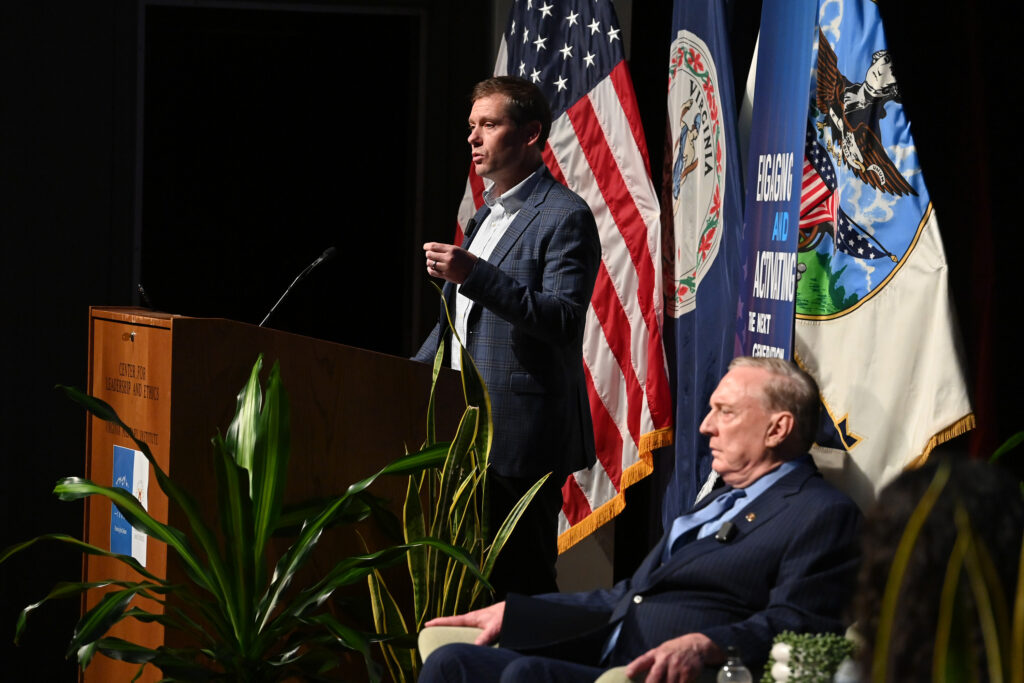
His final point was that if the rules-based order collapses or if the U.S. walks away from it, that will lead to a much darker world. “We would see more of the outright aggression we have seen from Russia and Ukraine, and we would have more friction and less prosperity in the global economy.”
The two opponents took turns answering multiple questions asked by the moderator, some of which were submitted by the livestream audience as well as those sitting in Gillis Theater.
In his closing statement, Macgregor stated that rather than spending billions of U.S. dollars in other countries’ conflicts, America’s interests should come first.
“This means committing our military power where only our direct security needs are at stake, protecting our own borders, but staying out of regions and conflicts where we have no interests that justify the expenditure of American blood and treasure. Our strategic focus should largely return to our own country. For if we are to survive, we must restore the foundation of economic prosperity.”
Brands closed by making three points.
“First, we have to be honest that the U.S. makes mistakes in foreign policy, and is guilty of being overambitious at times. The question is whether the role the U.S. has played in the world has been more good than bad. I think the answer to that is a resounding yes. That brings me to my second point. It’s easy to fixate on things we don’t like about the existing order, but the rules-based international order is meant to protect us from a greater downside, a greater evil, which is what would happen if the American-led system went away. That system has given the U.S. a huge degree of global legitimacy and global convening power. We shouldn’t lose sight of how amazing the historical achievements of the American-led order are. And my final point is the question of whether we should wish for the rules-based order to go away has to be followed by the question of what comes next? Yes, the rules-based order has problems, but is it preferable to a lawless system where there are no rules. International orders are never perfect, but this one is still better than the alternatives.”
The audience had the opportunity to record their stance on the debate topic in the pre- and post-debate polls. Prior to the debate, 38% agreed with the resolution, 37% disagreed, and 25% were undecided. After the debate, 48% agreed, 40% disagreed, and only 12% remained undecided. The debate in its entirety may be viewed here.
Following the debate, the audience was invited to a brief reception in the Hall of Valor to meet Macgregor and Brands.
The fall Steamboat Institute Campus Liberty Tour continues through November with debates at the University of Tennessee, Oct. 14; Middle Tennessee State University, Oct. 15; the University of Maryland, Oct. 27; Arizona State University, Nov. 5; and Colorado Mountain College, Nov. 17. All debates will be livestreamed. Additional information and how to register is available on SI’s website.