VMI Class of 2028 Celebrates Milestone
Reputation Rests in the Character of Those Who Wear the Ring
For some, November is a bleak and melancholy month. The days are short, the temperature drops, and the brilliant colors of autumn leaves fade. But for the Virginia Military Institute 2nd Class cadets, November heralds the long-awaited, highly anticipated Ring Figure. This year, the two-day celebration was held Nov. 19 and 20, and included the presentation of combat rings and class supper Thursday evening, followed by a family brunch, formal ring ceremony, ring blessing, and Ring Figure ball on Friday.
The first ring was designed by members of the Class of 1848 and was presented to graduates during finals celebrations. The design was simple. The word “Mizpah” was cut in the stone and on the inside of the band was engraved, “1 of 24, July 1848.” Mizpah, from the Hebrew, is translated as “the Lord watch between me and thee, when we are absent one from another.” The term signified brotherhood, the enduring connection among the 24 graduates of the Class of 1848. Modern rings have become increasingly larger and more elaborate in design, but the tradition of the class designing their one-of-a-kind ring remains the same and the word “Mizpah” is often still found.
The custom of 2nd Class cadets receiving the class ring was established in 1907, and the addition of the Ring Figure ball started in 1927 with the Class of 1928. The large modern rings are so renowned within military circles, that when Gen. Christopher J. Mahoney, 13th vice chairman of the Joint Chiefs of Staff, spoke during the commissioning ceremony last May, he made note of the them in his speech, “When a commander sees a VMI ring on a finger, they don’t see a recent college graduate, they see the ghosts of VMI,” referring to legendary alumni like Lt. Gen. Charles Kilbourne, VMI Class of 1894, and Lt. Gen. Chesty Puller, VMI Class of 1921.
The traditional presentation of the combat rings was held in Memorial Hall followed by the class supper in Crozet Hall Thursday evening. The Douglas Carter France III ’71 Memorial Award was presented by Warren J. “Buddy” Bryan ’71 to Andrew Ruocco, who received the honor through an election by his peers. Established in 1969 by the Class of 1971 as a tribute to their brother rat who lost his life in an automobile accident, the award is presented each year to the 2nd Class cadet who best emulates the qualities of France: excellent character, selflessness, graciousness, and enthusiasm.
The class nominated Sgt. 1st Class A. J. Burns, battalion operations and training sergeant in the Commandant’s Office, to be their honorary brother rat for the evening, and welcomed him to the podium with a standing ovation. Burns initially addressed the class as a big brother might, referring to them as, “disgusting, nasty things called rats,” before their Breakout two years ago. After much laughter and cheers, his message turned fatherly as he referred to the weight of the rings they would soon put on their fingers as a symbol of the weight they carry as cadets and the weight they will carry in the future. “As rats you carried sandbags, you carried logs, you carried each other. You learned that things get heavier when you’re tired. You also learned that weight becomes bearable when every single one of you carries their share.” He talked about the weight of expectations placed on them by the Institute, by themselves, and by their BRs. “Each of you carries frustration, doubt, exhaustion, the fear of failure, the fear that you might not be up to this. Some days, the person to your left and the person to your right were stronger. Some days you shared some of your strength with them. That more than anything else is what this experience is about. The ring represents the weight you carry together.” He closed by challenging them with, “Every day when you put your ring on, ask yourself whether your action is worthy of the people and the experiences that they represent. Ask whether you’ve been a better friend, a better citizen, a better leader, and better brother rat. Eventually, you will become used to wearing that ring and feeling that weight. But I hope you never forget the weight you carried to earn it.”
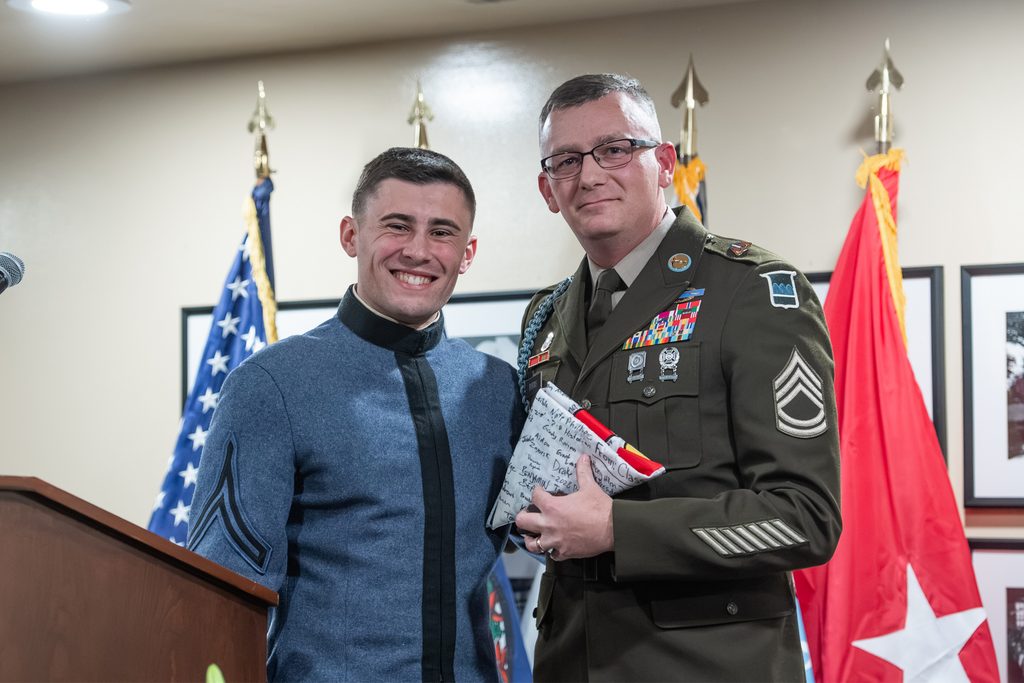
The class presented Burns with a signet dinner ring and a VMI flag signed by every member.
Following Burns’ speech, Anthony Allen Jr., the 2028 class president, approached the podium, signaling it was time for the main event, slipping on the combat rings. With teasingly slow and drawn-out instructions, Allen said, “Open the box, take the ring out, and raise your right hand.” Then with a rapid, good-natured command, “Put that thing on there!” As one, the cadets quickly slid their rings on their fingers. What followed was a cacophonic combination of cheers, hugs, screams, handshakes, taking of photos, and the clanging of rings on tables and chairs.
On Friday, a family brunch in Crozet Hall preceded the formal ring presentation ceremony where 2nd Class cadets received their individualized rings in Cameron Hall. Blake Hrisko, Ring Figure chairman, offered opening remarks and introduced the speakers, the first being Lt. Gen. David Furness ’87, superintendent. Furness shared the class ring is a unique symbol, connecting them to VMI’s cherished values and ideals. “Long after you graduate, you will have your ring to remind you of those core values to which we all committed when we came to VMI: A life of honor, selfless service, and a willingness to sacrifice for your country.” He reminded them that by accepting the ring, they join the roll of alumni who have carried the Institute’s values into every walk of life. “Wherever life takes you, this ring will serve as a constant reminder that you are expected to lead with integrity, to place service above self, and to meet every challenge with courage and fortitude. The reputation of VMI rests not on its buildings or traditions alone, but in the character of those who wear the ring.”
Following Furness, alumnus guest speaker retired Marine Lt. Col. Donnie Hasseltine ’97 addressed the class. Hasseltine talked to the cadets about the meaning of the ring and what it will demand of them. “VMI has always stayed true to its mission, evolving to give the nation the leaders it needs, both in everyday life and in times of deepest peril. That mission is why VMI graduates routinely punch above their weight in both the military and the private sector.” He noted that people look for unmistakable signs of character and proof that someone has been tested. “Your ring is one such proof. It is an instant bond of every brother rat and alumnus who knows the exact crucible that you survived. Yet the ring isn’t a receipt for what you’ve already endured; it is a standard for what comes next.” He encouraged them whenever they face difficult challenges, to look down at their rings and draw from it the strength and resolve to give them fortitude to persevere.
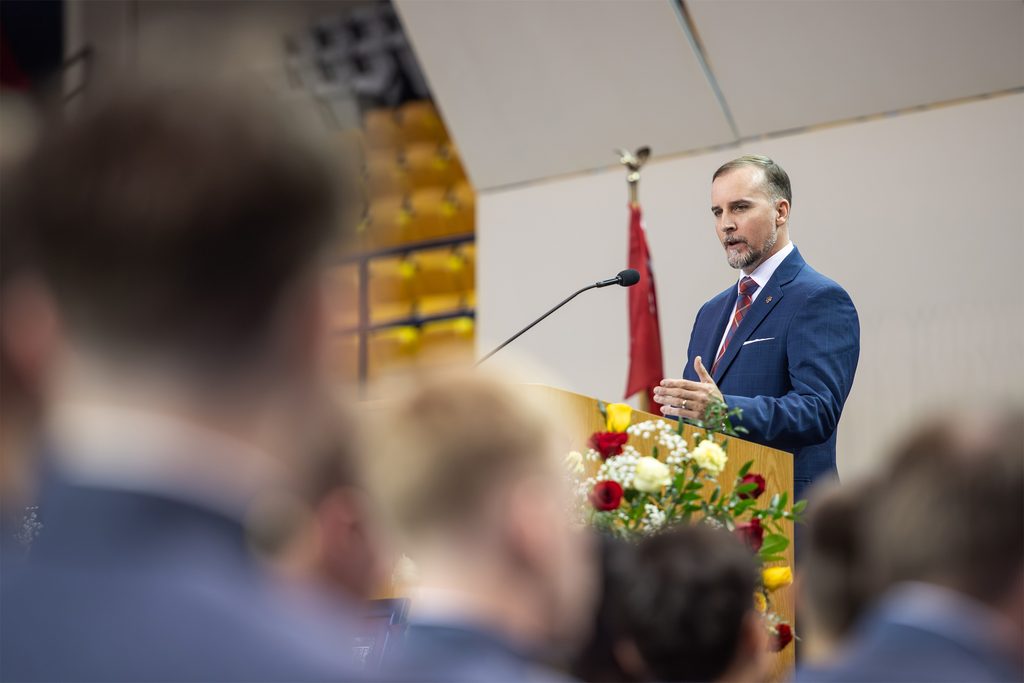
In closing, he encouraged them to follow their curiosity, embrace opportunity, and invest in yourselves. “When you apply VMI resolve to following your curiosity, embracing opportunities, and investing in yourself, you will not only succeed, but you will inspire others to do the same. In moments where you struggle or face doubt, those that you have inspired will come and lift you up, just as you have done with your brother rats. This, I think, is the heart of the leadership that VMI teaches.”
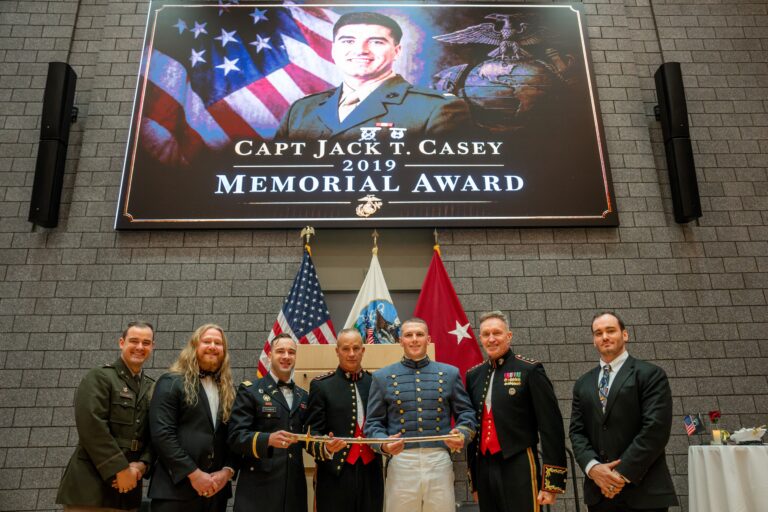
At the conclusion of his speech, the class presented Hasseltine with a saber.
Hasseltine majored in history and minored in English at VMI. As was a member of Band Company, he was instrumental in founding the Pipe Band and designing the VMI tartan. In the Marine Corps, he served 22 years as an infantry and reconnaissance officer, with combat deployments to Kosovo, Iraq, and Afghanistan. His military decorations include the Legion of Merit, two Bronze Stars, and the Purple Heart. Following his military service, Hasseltine began a private sector career in cybersecurity. He currently serves as the chief information security officer for Arkenstone Defense.
Later Friday afternoon, the ring blessing service was held in Memorial Hall. Capt. Eli Facemire ’19, associate chaplain, shared thoughts about his own class ring. He talked about the symbolism common to all members of his class that appears on the outside, as well as the personal inscription that appears on the inside of his ring. Cadets often include a phrase, scripture verse, or life motto that is particularly meaningful to them on the inside. Facemire chose the motto, “Honor God, never quit, finish well,” and the Bible verse, Psalm 46:1, “God is our refuge and strength, a very present help in trouble.” Facemire confessed he quoted the verse often when he was a rat. “I guess I was so nervous, I just said it out loud. I did it so often that my roommates actually memorized it too, and they started saying it before I did. But this verse, along with the rest of Psalm 46, is a powerful psalm, and it turned into a guidepost and a comfort to me throughout my cadetship, and it continues to comfort me today. And it reminds me that God is by my side. He’s present and he’s active. He cares, and He will never leave me nor forsake me, and He alone is the only true constant in my life.” Facemire went on to convey to the cadets that each of them has a set of principles that operates as a compass in their lives. He encouraged them to lean into those transcendent things and to continue to seek a deeper understanding of them as they progress in life.
Facemire’s talk was followed by cadets who offered prayers, verses, or blessings from their respective faiths, with Catholic, Protestant, Jewish, and Muslim faith groups then holding individual blessings in separate areas of the chapel.
Outside Memorial Hall, families gathered to admire the cannonball, no longer solid black, but painted to replicate in exact detail the Class of 2028 ring design, and nestled in an oversized wooden jewel box. Cadets posed for photographs beside the cannonball, proudly displaying their own rings, still safely cushioned in their boxes.
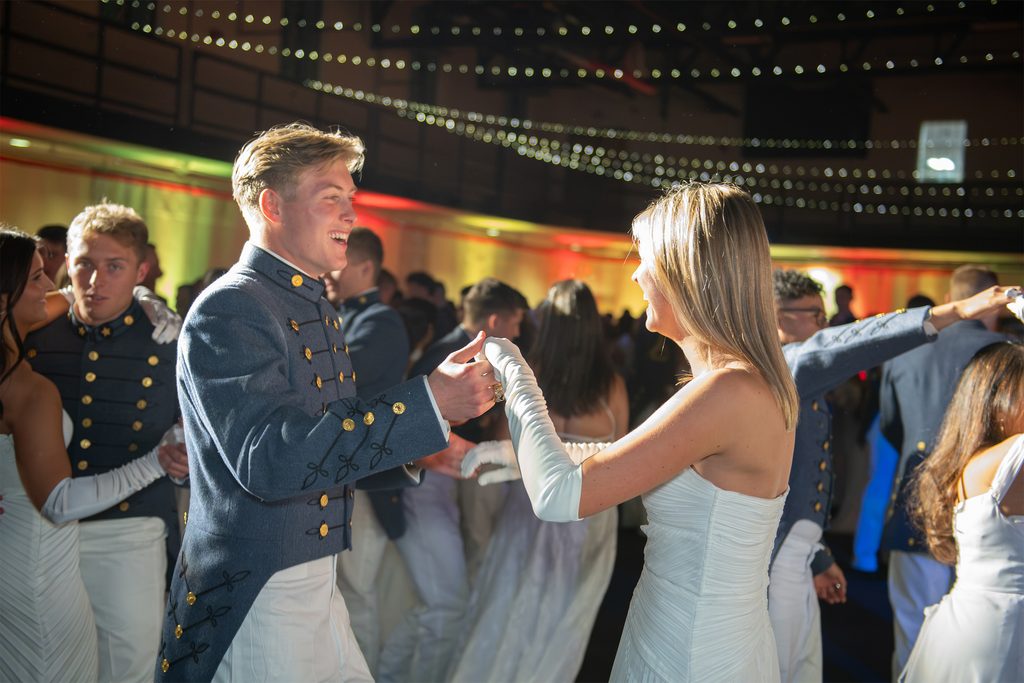
The evening was completed with the Ring Figure ball in Cocke Hall, where cadets were finally able to put on their class ring. The traditional dress code was coatees, white ducks, or long white skirts for cadets, and floor-length white gowns and elbow-length gloves for female civilian dates, and tuxedos with white bow tie for male civilian dates. Before entering Cocke Hall, couples proceeded through an arch of sabers held high by two opposing lines of cadets in Memorial Hall. They were also photographed as they posed in the larger-than-life replica ring. In the VMI Museum, a prominently located exhibit of most of the years’ rings are on display where visitors may observe the progression of size and detail of the rings, as well as their brilliant focal gemstones.