Annual Leadership & Ethics Conference Held at VMI
Virginia Military Institute’s 17th annual Leadership and Ethics Conference hosted by the Center for Leadership and Ethics (CLE) was held Oct. 25-27 on post. This year’s theme was “America: Forging Common Ground,” an extension of the CLE’s academic year’s theme of “American Spirit 2026.”
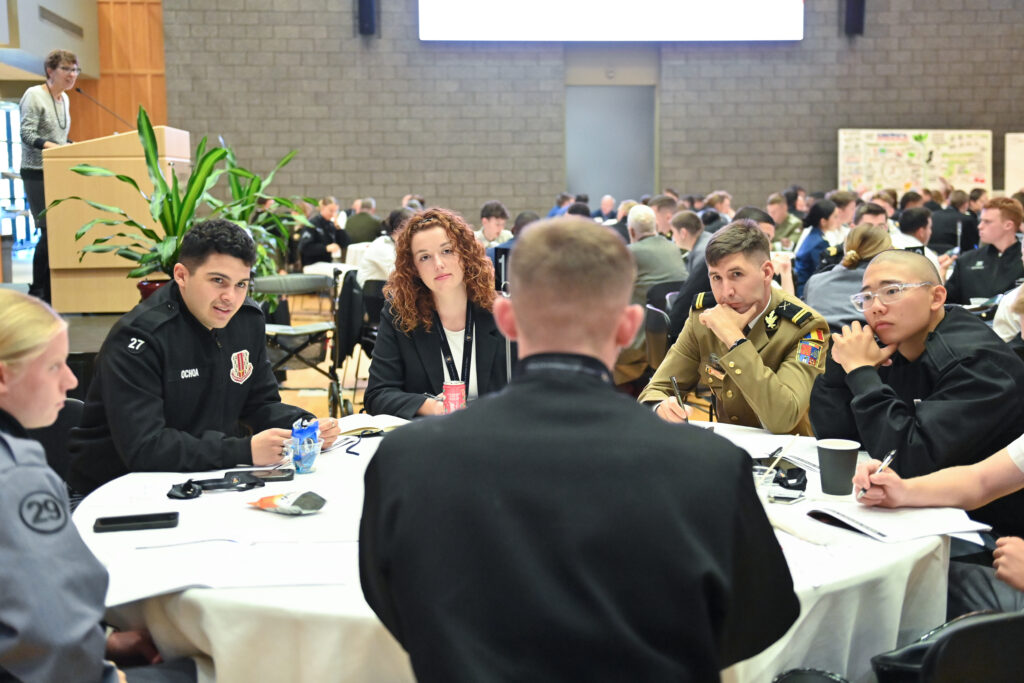
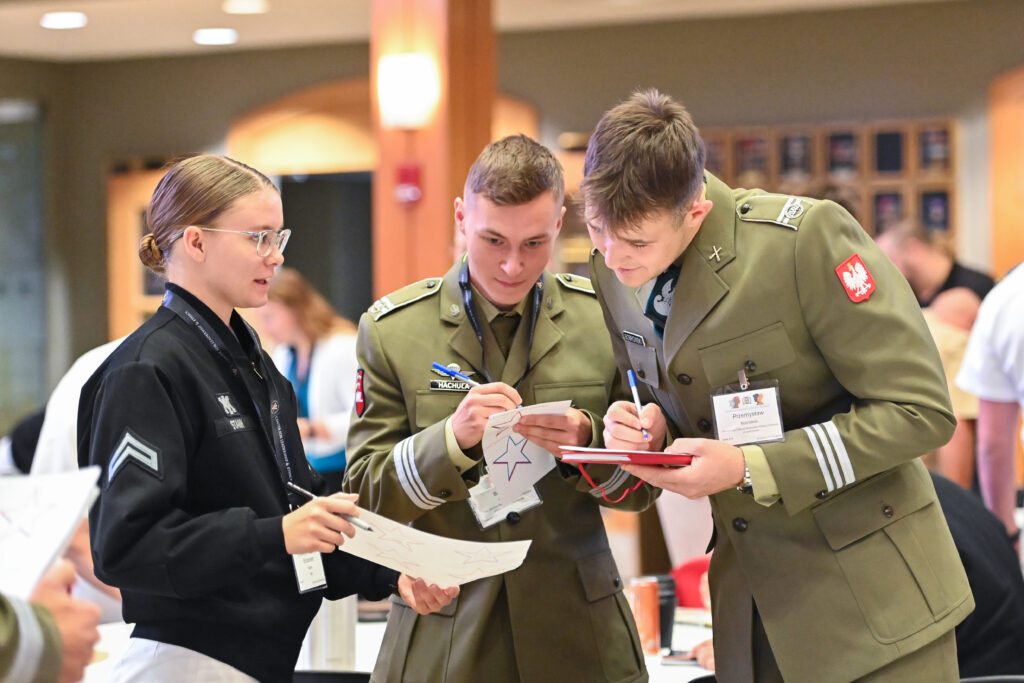
The conference hosted nearly 190 participants, made up of students and staff members from many colleges, universities, and military academies from around the world, including East Tennessee State University, Hampden-Sydney College, Marquette University, Purdue University, Texas A&M University, The Citadel, Tulane University, U.S. Air Force Academy, U.S. Military Academy at West Point, U.S. Naval Academy, University of Notre Dame, Virginia Tech, Washington and Lee University, as well as VMI. High school students from Fishburne Military Academy and the Montgomery County Public Schools Corps of Cadets also attended. Additionally, the General Jonas Žemaitis Military Academy of Lithuania, the General Tadeusz Kościuszko Military University of Land Forces in Poland, the Ludovika University of Public Service in Hungary, and the Nicolae Bălcescu Land Forces Academy of Sibiu in Romania sent delegations.
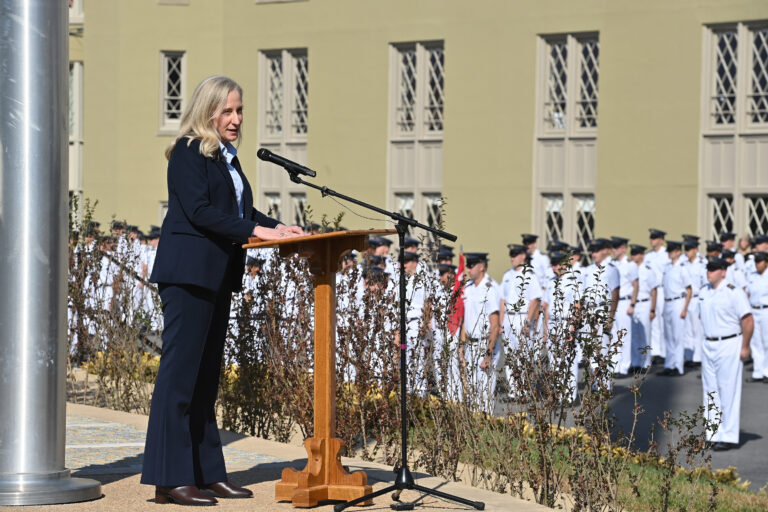
The conference opened in Marshall Hall with pageantry as the VMI color guard marched in carrying the flags as the Herald Trumpets played “The Star-Spangled Banner” in four-part harmony. Superintendent Lt. Gen. David Furness ’87 welcomed those assembled and encouraged them to network, share ideas, and reflect upon what it means to be an American. “Our goal is to embrace the spirit of debate and compromise that was set forth by our founding fathers. Thomas Jefferson and John Adams were presidents of the United States who held very different political views during the founding of our nation. While this led to a bitter rivalry, they developed a warm friendship later in their careers. As they demonstrated, we may not always agree with every decision that is made, but we appreciate honest debate and competitive spirit. We want to challenge you to think deeper and consider opposing viewpoints.” He concluded by reminding them that as leaders, they will be called upon to bring individuals together to help solve complex problems for the greater good.
Col. Dave Gray, executive director of the CLE, provided introductory remarks and explained how the theme of forging common ground would drive the conference program. “Throughout the conference, we’d like you to reflect on three simple questions: Who are we? What is our core belief? And how do we as Americans find common purpose? America today continues to stand as a land of opportunity where rugged individualism thrives. America still serves as a beacon for our core belief that all men are created equal and that freedom can be enhanced through principled debate and compromise.”
The first guest speaker of the conference was Marc Polymeropoulos, who worked for the Central Intelligence Agency (CIA) for 26 years before retiring at the senior intelligence service level. He was one of the CIA’s most highly decorated operations officers who served in multiple field assignments. He specialized in the Middle East and South Asia, and spent extensive time in Iraq and Afghanistan. He talked about why American exceptionalism matters and how, for many working in the national security field, the notion of America as the “bright shining city on the hill” was a driving force.
To illustrate his point, Polymeropoulos discussed the method he used to recruit agents to spy for the U.S. against their own authoritarian governments. “America was the good guys, we inspired people and movements globally to follow our lead. We recruited assets based on the ‘MICE’ principle, an acronym for Money, Ideology, Coercion, and Ego. That’s how I convinced Russians, Iranians, Chinese, members of al-Qaida, and others to spy against their governments or groups for us. Ideology is about America and all we stood for, and it mattered. I saw agents who risked their lives not for money, but for hope of a better future for their children who lived in corrupt and broken societies. The best Soviet agents in fact were motivated to spy for the U.S. by their intense hatred of the communist system. American democracy meant something to them.”
Polymeropoulos confessed though, he is concerned the notion of American exceptionalism is diminishing. “We have returned perhaps to an era of American imperialism, where U.S. economic interests are paramount, and the Reaganesque notions of the beauty and power of economic freedom and political liberalism are relics of the past. And on the other side of the aisle, we seem to want to apologize for all of America’s past sins, that everything we have done is awful and horrible. I think we can do better. America can be a power for good. We mean something. I didn’t risk my life for nearly 30 years for nothing.” He charged the future leaders in the audience to be the change the country needs to recapture and ensure the endurance of the glory of American exceptionalism.
Later in the day, Tanya Denckla Cobb, director of the Institute for Engagement & Negotiation at the Weldon Cooper Center for Public Service at the University of Virginia, led an exercise in the “Three Keys to Successful Negotiating.” She stated the three keys offer a potential roadmap for problem solving among family members, friends, and professional colleagues. The first key is to listen for understanding and to acknowledge the concerns of others and the impacts they have experienced. The second key is to ask open-ended questions to discover what is important and concerning to others. The third key is developing options for mutual gain.
Central to the conference’s programming were small group discussions; interactive activities; and speakers focusing on civil discourse, collaboration, compromise and negotiation techniques. One activity involved role-playing a fictional scenario—but one the participants may truly face one day while serving in the military or in a department of the federal government—of developing a national immigration strategy. Divided into groups, the students considered several different scenarios and had to make a recommendation using the three keys of negotiation.
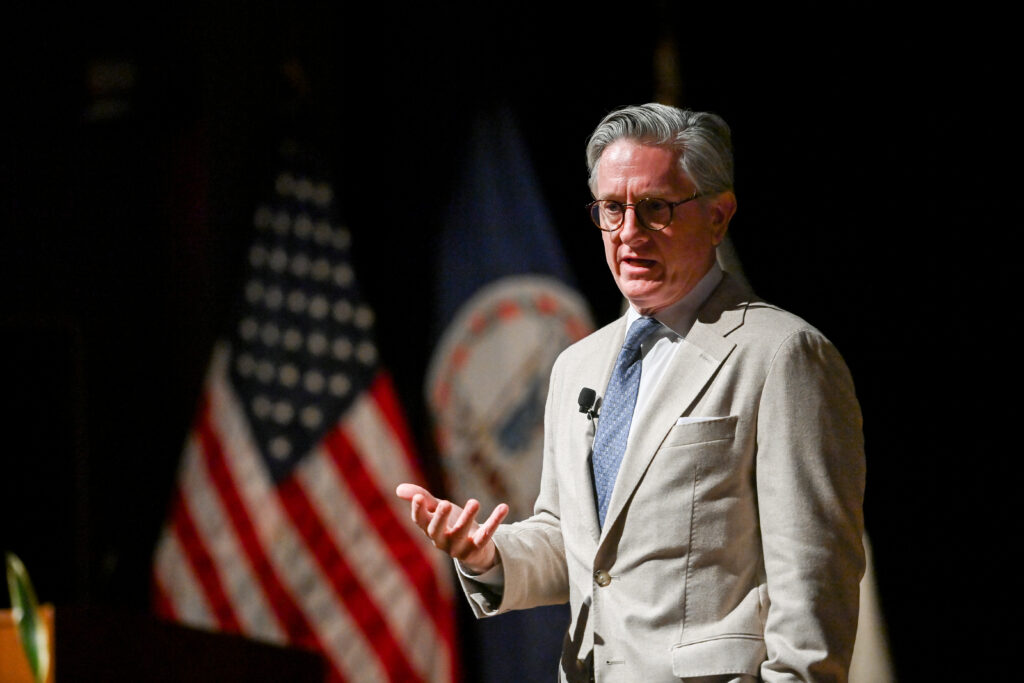
The second day of the conference opened with Robert Greenway ’90, the H.B. Johnson Jr., 1926 Distinguished Lecture Speaker. Greenway, a decorated special forces combat veteran and senior vice president at American Global Strategies, advises clients on defense strategy, intelligence-related risk, and international security. He spoke on “America’s Role in the Changing World Order.” He addressed the nation’s history, its leadership, mistakes that have been overcome, and what must be built and preserved for the next generation. “We live in the greatest country in the world, paralleled only by the most powerful empires of the past: Athens, Rome, and London. We came from the same heritage. We’re cut from the same cloth, and we came by it honestly. But as the adage goes, great power brings great responsibility. Unlike civilizations of our ancestors, we have to learn from the collapse and course of their empires.” He cited the commonly held quote, “Good times make weak men, weak men make hard times, hard times make strong men, and strong men make good times,” and warned that hard times are sure to come. He cautioned our enemies seek nothing but the destruction of America and its legacy, because they have none of their own. “No matter how hard they try to destroy it, and they certainly have tried with the attacks on 9/11, Pearl Harbor, and the sinking of the Lusitania, they fail to realize that these events don’t destroy us; they galvanize us. That’s the American spirit.”
Greenway alerted of the threats from within the country, and encouraged his listeners to open their eyes to see—as painful as it might be—and allow conviction to build within them. “You can preserve the foundations that made us great and that we may defend our American inheritance. To do so, you have to fight for God, for family, for country, and for our common ground. After all, what greater honor is there as an American?”
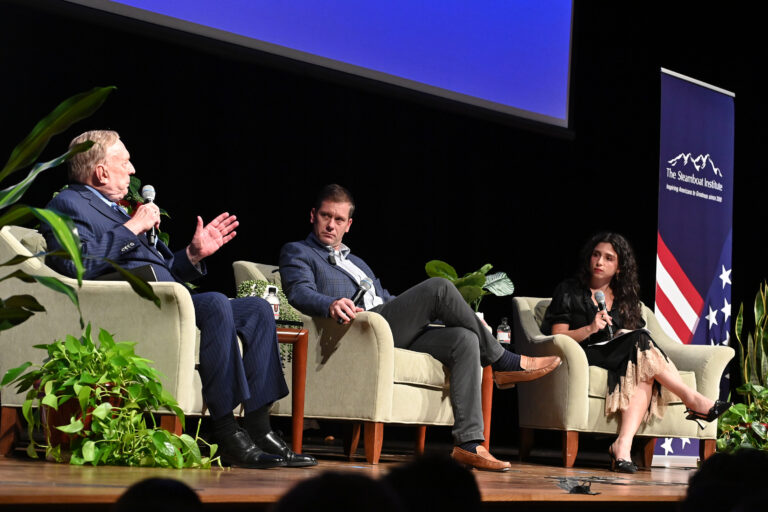
The concluding presenter of the conference was the Caroline Dawn Wortham ’12 Leadership Speaker, Beverly Gage, an American history teacher at Yale University and Pulitzer Prize winning author. Through a moderated interview, Gray asked Gage questions about her latest book, “This Land is Your Land: A Road Trip Through U.S. History,” which was written for the 250th anniversary of the Declaration of Independence. The book covers historic locations throughout the U.S. that Gage visited over a period of two years. They represent specific moments from 1776 to the present and include places such as Independence Hall, the Alamo, Mount Vernon, Mount Rushmore, the Erie Canal, and Disneyland.
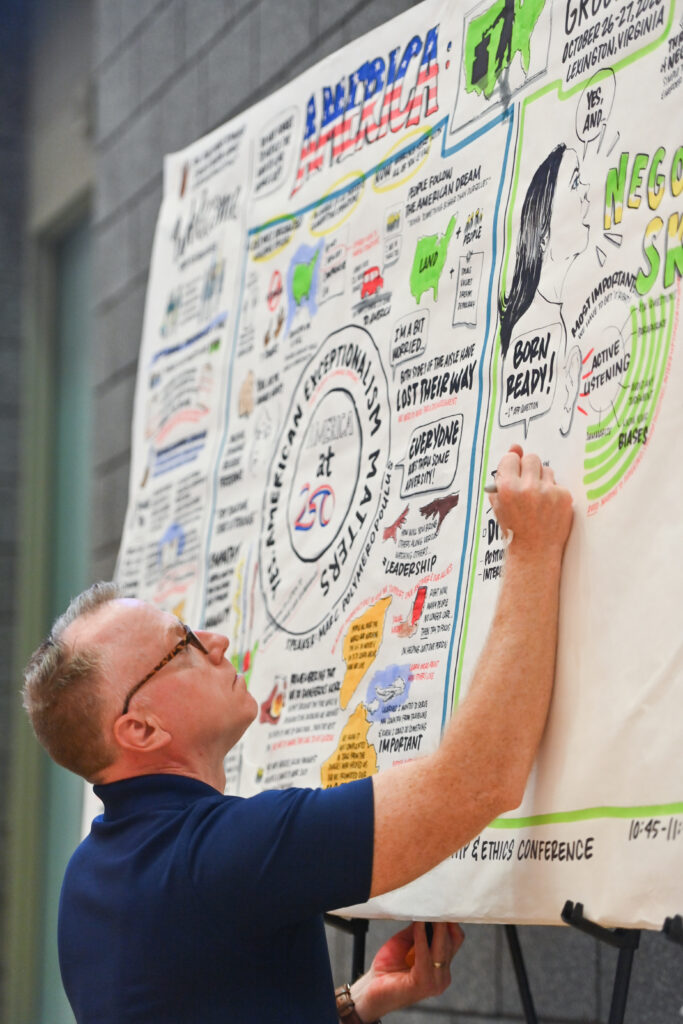
A whimsical addition to the conference was provided by RedTale graphic recorder, Wade Forbes, who sketched the entire conference—while it was happening—on poster paper. With a toolbelt full of colorful markers on his hip, Forbes captured, in real time, conference speeches and activities into comic-like visuals to help explain ideas and provide clarity to messages. At the end of the conference, participants were able to review the visual artifact, which helped solidify what they had learned over the two days.
VMI regimental commander Kimlong Nguyen ’27 attended the conference and said it provided invaluable insights into negotiation. “Those techniques are essential for young leaders, empowering us to achieve our goals while nurturing positive, lasting professional relationships.”
Bailey Pellegrini ’28 stated the speakers were insightful and she learned a lot about their respective fields. “With inside knowledge on how parts of the CIA operate, I’ve become interested in exploring more forms of service for my future. A big takeaway I got from Mr. Polymeropoulos is that leaders are remembered for how they treat their team and pass the torch.”
Next year’s Leadership Conference will be held Oct. 25-26, 2027, with an announcement of the theme and title coming in the spring.