
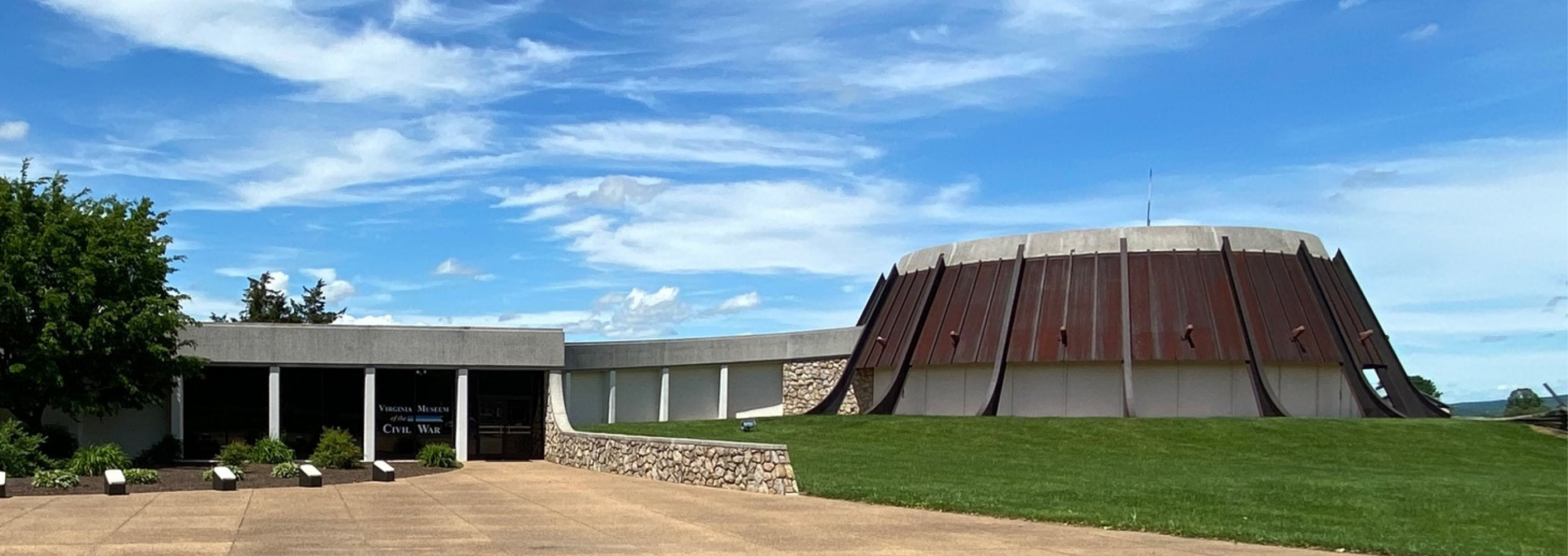

Union Army Command
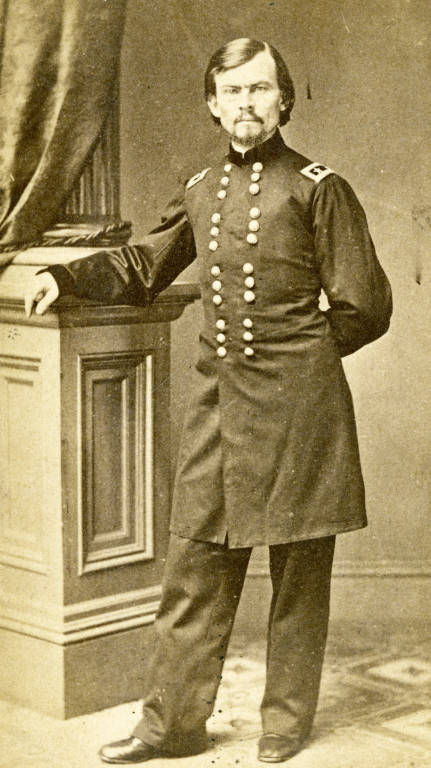
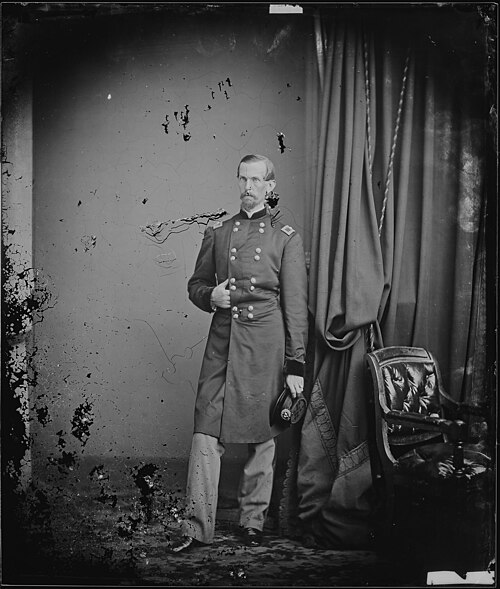
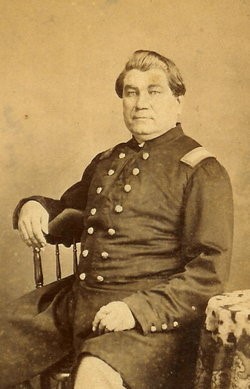
—Photos from VMI Archives, the National Archives and Records Administration, and WikiTree.
Major General Franz Sigel
Commander of Union Department of West Virginia
Born: 1824
Where: Sinsheim, Baden
Military Service: An officer in August Willich’s German Republican Army. Sigel commanded one of the four columns in April 1848 and was defeated at Freiburg. He fled to Switzerland and returned a year later to participate in a new revolution. He commanded troops guarding Baden’s frontier and was again defeated.
Immigration: He came to the United States in 1852 and became an administrator of a German language school in New York. He eventually moved to St. Louis and became director of the city schools in an area with a large German immigrant population.
Civil War Military Service: Sigel was drilling a new regiment of volunteers in St. Louis when war was declared. He participated in the successful capture of armed Southern sympathizers at Camp Jackson on May 10, 1861. His next action was a skirmish near Carthage, Missouri on July 5, 1861. These twin victories made him a folk hero among the German immigrants and his appointment as a brigadier was thought to bring valuable votes. His poor service during the Battle of Wilson’s Creek on August 10th contributed to the severe defeat of US forces there. He was blamed severely for the defeat but found his popularity among the ranks was still good. In November, Major General John C. Fremont was appointed as the commander of Union forces in Missouri. Many Germans were outraged that the job wasn’t given to Sigel, including the general himself. A private letter calling General Halleck a “slick lawyer” made it into a newspaper and the blood feud between the two only escalated. He tendered his resignation from the army a short time later. Sigel traveled to the capitol to rally support for his promotion. He talked to important Germans including prominent Midwest Congressmen. The promotion to Major General came in March of 1862.
The same month he fought well at the Battle of Pea Ridge and replaced John C. Fremont in command of a Corps in Virginia. Later that year he fought in Jackson’s celebrated Valley campaign and in the second battle of Manassas. He would later temporarily command a grand division during Burnside’s Fredericksburg campaign but would not see any action there. He was returned to his corps a few days later and remarked it was “exceedingly unpleasant.” Sigel asked to be relieved and in February of 1863 went home for medical reasons. His standing among fellow Germans was greater than ever, and he continually lobbied his cause with speeches in major cities. Sigel was officially appointed to command the Department of West Virginia by order of the War Department on February 29, 1864. He reached the headquarters in Cumberland, Maryland on March 11 to the sounds of an artillery salute. His new department included the state of Maryland west of the Monocacy River, some of Loudoun County, Virginia, the Shenandoah Valley and West Virginia.
Sigel’s part of the new campaign was designed to take troops away from Lee, destroy supplies and regain loyal territory. His mission was to assemble a force to march on Staunton. The cavalry under Averill and Crook would be supplied there for the move on Lynchburg. Grant’s orders to Sigel were to be ready to move by May 2, 1864.
He began to assemble his expedition force on April 20 in Martinsburg, West Virginia. The general arrived at the headquarters on April 25 to personally inspect the assembled troops. Sigel ordered a grand review of his army on April 27. The parade was a dismal failure; no one could seem to find their position in line. One soldier lamented that… “such a time as we had finding our places in the line was never seen before.” The final troops attached to Sigel’s army arrived in town on April 28. His force would consist of one infantry division with two brigades. The cavalry was organized into a division with two small brigades and the artillery attached to force consisted of five batteries. The general sent marching orders to all commanders at five O’clock on April 29. Threatening weather and sore feet caused them to bivouac near Bunker Hill. On April 30, the command stayed in camp and drilled for four hours.
On May 1, the army was again in full swing up the Valley to Winchester. It arrived there late that afternoon around 4:30 P.M. Captain John McNeill raided the B&O Railroad shops near Piedmont, MD on May 5 leaving behind only smoke and ashes. Sigel under pressure sent out Colonel Jacob Higgins with 500 men of the 22nd PA and 15 NY cavalries. The orders were to intercept Captain McNeill. That same day the commanding general ordered a sham battle, which again ended in a confusing debacle for some like the 34th Massachusetts Infantry. This unit advanced as skirmishers and was forgotten. The same battle was ordered again the next day with a similar conclusion, leading Colonel Wells to say…”I’ve lost all interest in it and the service…I won’t serve under such fools; and you are a fool if you do”.
On May 8 orders for the commanding general were issued to march at 6:00 A.M. The command finally moved on May 9 at 7:00 A.M. with orders to proceed to Woodstock. A large cavalry screen of advanced guards and flankers protected the infantry. The eastern detachment of 300 troopers of the 1st NY (Lincoln) Cavalry was sent to Woodstock and then to New Market to secure the road to the gap.
The detached horsemen of Jacob Higgins finally caught up with McNeill on the evening of May 7 and forced them to withdraw. By May 10, John Imboden with 800 men had set a trap for the men from Pennsylvania and New York at Lost River. A short engagement ensued, then a race for the Potomac. The fleeing Yankees galloped through Romney and then on to Old Town, MD. This ambush cost Sigel 500 cavalry when they were needed the most. The next cavalry engagement occurred at the base of Massanutten Mountain across Smith’s Creek on May 13. The forces were from Boyd’s column and Imboden’s district troops. The Union loses totaled over 100 and led to another mismanagement of men and materiel.
On May 14 the chief of staff Major General Julius Stahel ordered Colonel Moor to advance on Rude’s Hill outside of New Market with about 1/3 of the army. Sigel issued orders to march on Mount Jackson at 5:00 A.M. The general arrived at Moor’s line about noon on May 15th and ordered a retreat. On the new defensive position on Bushong’s Hill, he ordered a charge of the 34th Mass., 1st WV, and the 54th PA: 1700 men near 3:00 P.M. The attack repulsed, his lines broken led to a full retreat to the pike. The army had crossed the river and fired the bridge around 7:00 P.M. Sigel telegraphed his superiors at 8:00 P.M. stating that …A severe battle was fought today at New Market between our forces and those of Echols and Imboden under Breckinridge. Our troops were overpowered by superior numbers.” Orders from headquarters went out to the men at 9:00 P.M. to march to Edinburg. The army arrived outside of Strasburg at 5:00 P.M. on May 16. Sigel sent a wagon loaded with supplies back to the town under a flag of truce on May 17, the same day he crossed Cedar Creek.
On May 19, the War Department officially replaced Sigel with a Major General David Hunter. Hunter arrived at Sigel’s headquarters at the Hite House. Sigel was offered his choice of lesser command and chose the reserves in Harper’s Ferry. Strother noted during a final visit with the general on May 22, that …”the tears were standing in his eyes and his lips were quivering.”
When General Hunter left in May, Sigel was left with almost 10,000 reserves in Martinsburg, WV. General Early sent a command of cavalry to the town during his expedition to Washington in July. Sigel fled without much of a resistance on July 3, leaving huge amounts of military supplies to the enemy. He was permanently relieved of command on July 7. He went home to await orders that never came and resigned his commission on May 4, 1865.
In 1867 he moved to New York and was made a commissioner of the Hudson River West Shore Railroad. He was made vice-president the next year but declined to make an unsuccessful bid at the secretary of state for New York. In 1871, President Grant placed him on a commission to purchase Santo Domingo. He held several minor appointed offices and lectured throughout his senior years. He began an autobiography that was never completed. He died on August 21, 1902.
Brigadier General Jeremiah Sullivan, First Infantry Division
Source: Generals in Blue
Jeremiah Cutler Sullivan, son of a Virginia-born lawyer who became a justice of the Indiana supreme court, was born on October 1, 1830, in Madison, Indiana. He entered the navy in 1848 and was commissioned a midshipman, serving at sea on four different vessels before resigning his commission in 1854 to study law. At the beginning of the Civil War, he helped recruit and organize the 6th Indiana volunteers and as a captain took part in the action at Phillipi, Virginia on June 3rd. When the 6th Indiana was mustered out, Sullivan became colonel of the 13th Indiana, which enlisted for three years, and fought at Rich Mountain. During the Shenandoah Valley Campaign of 1862, he commanded a brigade of Shield’s division at Kernstown and was commissioned a brigadier general to rank from April 28. Soon after, he was sent west and assigned to command a brigade in W.S. Rosecran’s Army of the Mississippi, which he led at the battles of Iuka and Corinth. Later that fall he was put in charge of the District of Jackson, Tennessee, where he had the unenviable job of pitting scattered garrison troops against the forces of Nathan B. Forrest. Sullivan served as acting inspector general on U.S. Grant’s staff for a time early in the Vicksburg campaign and after the capitulation became James B. McPherson’s chief of staff. In September 1863, he was relieved in the west and returned to duty in the Department of West Virginia under General Benjamin F. Kelley, his father-in-law, who assigned him a division with which to guard the B & O Railroad from the Monocacy River west to Sleepy Creek. After Phillip Sheridan took charge of the Middle Military Division which embraced the Department of West Virginia, in the summer of 1864, Sullivan seems to have been waiting for orders for a time. In March 1865, Winfield S. Hancock stated in an official communication that he wished no officer on duty with who had been sent to the rear by his predecessor Sheridan. General Sullivan’s resignation was accepted by the War Department on May 11, 1865, and, perhaps significantly, he did not receive the brevet of major general, despite the fact that he was in divisional command for many months.
After the war he resided in Oakland, Maryland, for a time, moving to California about 1878. Although a lawyer by profession, he did not practice and was employed, when employed at all, in minor clerical jobs. He died in Oakland, California, on October 21, 1890, and was buried in Mountain View Cemetery.
Colonel Augustus Moor, First Brigade
Augustus Moor was born March 27, 1814, in Leipzig, Germany. He came to the United States as a young man and settled for a while in Pennsylvania. In 1837, at age twenty-three, he took part in the Seminole Indian war as a first lieutenant in the First Pennsylvania Volunteers. Later he moved to Cincinnati and served as a captain of Ohio troops in the Mexican War from May to October 1846. At the beginning of the Civil War, he was appointed colonel of the 28th Ohio Volunteers, a regiment composed entirely of Cincinnati Germans. His regiment suffered many defeats in campaigns in western Virginia and Maryland. He was captured at the battle of South Mountain in September 1862 and was placed in a Confederate prison camp until exchanged.
At the Battle of New Market, Colonel Moor commanded the First Infantry Brigade comprised of three regiments of Ohio troops and one regiment of troops from Connecticut. He was honorably mustered out of the service on July 23, 1864, and was named a brevet brigadier general of volunteers. General Moor spent the remainder of his life in Cincinnati where he died October 11, 1883, at age sixty-nine.
Major Henry Peale, 18th Connecticut Infantry
Residence: Norwich, CT
He was commissioned a captain on April 22, 1861 and on May 7, 1861 was placed in command of Company C of the 2nd Connecticut Infantry. He was mustered out of this regiment on August 7, 1861 at New Haven. On August 18, 1862 he took command of Company F, 18th Connecticut Infantry and was promoted to major a year later on May 20, 1863. Major Peale commanded the regiment during the Battle of New Market and was later promoted to Lieutenant Colonel on October 10, 1864. He was mustered out of government service on June 27, 1865 at Harper’s Ferry, WV.
Lieutenant Colonel Gottfried Becker, 28th Ohio Infantry
Residence: Chicago, IL
He was born in Germany in 1827. He is mentioned as a veteran of the German Revolution of 1848. He first fled to Switzerland, and later to the U.S. in 1850. In 1860, he was in Chicago, Illinois where his occupation was the editor of the German newspaper Turnzeitung.
Becker was commissioned as a Lieutenant Colonel in the 28th Ohio Infantry. In May 1862, the 28th Ohio was in Western Virginia, where it joined General Cox’s Kanawha Division. Colonel Augustus Moor was assigned to command the brigade, leaving Lt. Colonel Becker in command of the regiment for the rest of the war. Becker died in 1867.
Colonel James Washburn, 116th Ohio Infantry
Spirit of Democracy, Woodsfield, Ohio dated May 26, 1898
Col. James Washburn, aged 77 years, a former resident of Woodsfield, and who will be remembered by many of our older citizens, died at his home in Richland Center, Wis., May 13. Mr. Washburn had been ailing for some time but his condition was not considered serious until within a few days of his death. Colonel Washburn’s military record is a brave and gallant one. He enlisted in April, 1861, and was made captain of Company B, 25th Ohio-volunteer infantry.
He served as captain of that company in all of the campaigns in which the regiment took part, until August, 1862, when the 116th regiment of Ohio volunteer infantry was organized and he was commissioned its colonel by Governor Tod. He served in all the campaigns in the Shenandoah Valley until July 18, 1864. At the battle of Snicker’s Ferry he was terribly and it was thought mortally wounded, being shot in the head, the ball entering the left eye. From this wound he never fully recovered and was never able to again join his regiment, but was assigned as commandant of the post at Wheeling. He received his discharge from the service in July, 1895. Mr. Washburn with his family removed from Woodsfield to Wisconsin in 1868. He leaves a wife and four children.
Major Horace Kellogg, 123rd Ohio Infantry
He was the commanding officer 123rd O.V.I. Civil War. Battles: Winchester, Berryville, New Market, Piedmont, Lynchburg, Snickers Ferry, Winchester II, Opequon, Fishers Hill, Cedar Creek, Petersburg, High Bridge.
Cavalry
Major General Julius Stahel, USV
Source: Generals in Blue
Julius Stahel, whose Hungarian surname was Szamvald, was born in Szeged, Hungary, on November 5, 1825. After attending school in Szeged and Budapest he entered the Austrian army as a private and rose to lieutenant, but in the struggle for Hungarian independence, he cast his lot with the revolutionary cause and, after the movement was suppressed with the aid of Prussia in 1849, fled the country.
He lived in London and Berlin as a teacher and journalist before he came to America in 1859. For the next two years, he was employed by a German-language weekly in New York City. In 1861 he and Louis Blenker recruited the 8th New York (1st German Rifles), becoming lieutenant colonel and colonel respectively; at the first battle of Manassas, the regiment aided in covering the fleeing Union forces from that celebrated debacle. On August 11, 1861, Stahel succeeded Blenker as a colonel, and on November 12 was advanced to brigadier general. He fought under John C. Fremont in the Shenandoah in the spring of 1862, opposing Stonewall Jackson. At Second Manassas he commanded the 1st Division of Franz Sigel’s corps after the wounding of General Robert C. Schenck and then was in reserve under him and Sigel until he was assigned to the command of the cavalry in the Washington defenses in the spring of 1863. When he was promoted to major general of volunteers on March 17, 1863, he ranked immediately after General Phillip Sheridan. In the spring of 1864, General Stahel led a division of cavalry under General David Hunter, again in the Shenandoah and West Virginia, in the course of which both men were virtually forced out of the active theater of war. However, at the Battle of Piedmont on June 5, 1864, he was greatly distinguished in an action that subsequently led to the award of the Medal of Honor in 1893.
Thereafter, he served on court-martial duty until he resigned his commission on February 8, 1865. After the war, he served for years in the consular service in Japan and China. Upon returning to the U.S., he became connected with the Equitable Insurance Company of New York. A lifelong bachelor, he died in a New York hotel on December 4, 1912, at the age of 87 and was buried in Arlington National Cemetery.
Colonel William B. Tibbits, First Cavalry Brigade
WILLIAM BADGER TIBBITS, the youngest son of George M. Tibbits, was born at Hoosick, in Rensselaer County, on March 31, 1837. His early youth was passed partly in Troy and partly in the country, and after having received elementary instruction at various schools, he was graduated at Union college in 1859. He was engaged in business at Troy when, on the morning of April 15, 1801, the warning tones of the voice of the Rebellion starting at the South reached his ears as it did the ears of millions of freemen. Heeding its appeal, he at once left his office and obtained papers authorizing him to raise a company in a regiment which it was that day decided should be formed in Troy. He never returned to the business which he had abandoned, and in consequence of this abandonment, the business proved to him a total loss.
His efforts as a soldier, from this point forward, were unwearied. He recruited more men for his company than any other person connected with it, and it was accepted, on April 23, 1861, as a part of the 2d Regiment New York State Volunteers, with the following officers: Captain, William B. Tibbits; 1st Lieutenant, James Savage; 2d Lieutenant, William Sullivan. The company was known as G Company, and Mr. Tibbits was mustered into the service as captain on May 14, 1861. An idea of the nature of his services during the next seventeen months may be gained from a perusal of the following recommendation:
“Headquarters Carr’s Brig., Sickles’ Div.
Camp at Fairfax Seminary, Va., Oct. 18, 1862.
“General, — I have the honor to recommend the promotion of Captain William B. Tibbits, Second New York State Volunteers, to be major vice George W. Wilson, resigned. Captain Tibbits is the senior, and one of only two original captains left with the regiment. He has been with it on every picket, march, and reconnaissance, and in every skirmish and battle, at Big Bethel, Fair Oaks, Glendale, Malvern Hill, Bristow, and Bull Run. At Bristow, he particularly distinguished himself and was honorably mentioned for gallant and meritorious conduct at Bull Run. His vast experience, undaunted courage, and excellent judgment well qualify him for the position for which I have had the honor to recommend him. I have the honor to be,
“Your most obedient servant,
Joseph B. Carr, Brig.-Gen., U. S. V.
“To Brig.-Gen. Thomas Hillhouse,
State of New York, Albany, N. Y.”
This recommendation was duly honored by the State of New York, and Capt. Tibbits was appointed major of the regiment, his commission bearing date Oct. 13, 1862. The term of the 2d Regiment expired in the following year, and on May 23, 1863, Maj. Tibbits was mustered out with the regiment, at the city of Troy. June 17, 1863, he procured authorization papers to raise a cavalry regiment, to be known as the Griswold Light Cavalry, to serve for three years unless sooner discharged. The regiment received its name from the Hon. John A. Griswold, then the representative in from the district embracing the city of Troy. About the time that the completion of the regiment was assured, a number of Maj. Tibbits’ personal friends testified their appreciation of his bravery and merit by the gift of a sword, which bore the following inscriptions:
“Col. Wm. B. Tibbits — from a few of his friends, as a token both of their personal regard and of their admiration of his gallantry. Troy, N. Y., Nov. 18, 1863.”
“New Market Bridge, Big Bethel, Fair Oaks, Glendale, Malvern Hill, Bristow, Second Bull Run, Fredericksburg, Chancellorsville.”
On Jan. 1, 1864, Maj. Tibbits was mustered in as colonel of the 21st New York (Griswold Light) Cavalry, with rank as a colonel from Nov. 20, 1863. The first engagement in which the regiment took part was at New Market, Va., on Sunday, May 15, 1864. His services, performed early in the succeeding June, were acknowledged as follows:
“Baltimore, Md., August 29, 1864.
“Colonel, —I regret exceedingly that the suddenness with which I left my command at Staunton, Va., on account of my wound, prevented me from issuing the order which I had intended to, and which you so justly deserved, commending you for your gallant conduct at the battle of Piedmont, June 5, 1864, and on which day it was my pleasure to thank you and your gallant regiment (on the battlefield) for the brilliant success they had achieved. The faithful and efficient manner in which you discharged your every duty while under my command has won for you my highest esteem and best wishes for your every undertaking; and as a merit for the criterion for promotion in our army, I feel confident that the promotion for brigadier-general will be the reward for your gallant services.
“Very sincerely and truly, Your friend,
Stahl, Maj. Gen.
“To Col. William B. Tibbits, 21st New York Cavalry.”
For the two months following the battle of Piedmont his command was constantly employed. Labors performed and dangers undergone a character so trying as were those that filled up this period could not fail to be recognized by those whose duty it was to know when work was well done. That such recognition was not lacking appears by the following communication:
“Headquarters 1st Cavalry Division, Dep’t of West Virginia.
“Hancock, Md., Aug. 5, 1864.
“Maj.-Gen. David Hunter, Commanding Department of West Virginia, Monocacy Junction, Md.
Sir, —I have the honor to recommend for gallantry in action, and efficiency under all circumstances in the field, Col. William B. Tibbits, 21st NY Vol. Cavalry, now commanding the first brigade of this (1st Cavalry) Division. This officer has served under my command since the 10th of June, 1864, and I have found him, on all occasions, a competent, faithful, and gallant officer. He has, on several occasions, distinguished himself in action. His meritorious conduct has commanded the admiration of myself and his command. I would respectfully recommend him as worthy of promotion to the rank of Brigadier General U. S. Volunteers. I would respectfully call your attention to special mention made of this officer in my official report of July 27, 1864. This report has been forwarded to the head-quarters of Brevet Major-General Crook, commanding forces in the field, Department of West Virginia.
“I am, General, very respectfully, Your obedient servant,
A. N. Duffie, Brig.-Gen.”
On the receipt of this communication it was indorsed in these terms:
“Headquarters Department West Virginia.
“Harper’s Ferry, Va., Aug. 7. 1864.
“Respectfully forwarded to the Adjutant-General of the army, approved, and earnestly recommended. See enclosed copy of General Orders, No. 63, current series, from these headquarters.
“D. Hunter, Major-General Commanding.”
The general order referred to was as follows:
“Headquarters Department of West Virginia.
“Harper’s Ferry, Aug. 7, 1864.
“General Order No. 63.
“Colonel William B. Tibbits, 21st New York Cavalry, commanding 1st Brigade, 1st Cavalry Division, has been highly complimented by his division commander for gallantry in action and efficiency under all circumstances in the field, and having been recommended as a competent, faithful, and valiant officer, worthy of promotion to the rank of Brigadier-General United States Volunteers, the Major-General commanding takes pleasure in commending to the command the conduct of Colonel Tibbits, and in approving the recommendation for his promotion.
“By order of
“Maj.-Gen. Hunter.
“P. G. Bier, A. A. General.
“Official 1st Division: E. W. Clark, A. A. G.”
This deserved recognition of the conduct of a soldier — of whom it was said he begged the privilege of charging the enemy when others would unwillingly obey orders that involved any risk of personal safety — was made still more complimentary by being read on dress-parade to each command in Hunter’s army. On Oct. 21, 1864, the regiment received from the Hon. John A. Griswold a stand of colors, the regulation-flag, and the regimental standard, both being of heavy silk, and bearing appropriate devices and embellishments beautifully embroidered upon them. On Nov. 17, 1864, Col. Tibbits received official communication from the War Department, conferring on him the well-earned designation of brevet brigadier-general, with rank from Oct. 21, 1864. Not only did his services extend through the war, but after its conclusion, he was ordered west, on the plains, and it was not until in September 1865, that he received permission, while at Leavenworth, Kan., to return to his home at Troy, and there await orders.
He was made a full brigadier-general, and received the rank of major-general U. S. V., by brevet. The following are the names of the places at which engagements occurred — all of them in Virginia — in which Gen. Tibbits participated while in the cavalry service: New Market, Piedmont, Lynchburg, Hillsboro’, Snicker’s Gap, Ashby’s Gap, Kernstown, Winchester, Martinsburg, Charlestown, Halltown, Nineveh, Roods Hill, and Liberty Mill or Gordonsville. He was mustered out under General Order No. 168, to date from Jan. 15, 1866.
For several years past Gen. Tibbits has been a great sufferer, resulting from injuries received while in the service. Such is the merest outline of the career of a man whose sound judgment when advice was needed, whose bravery when fighting was to be done, and whose celerity in a movement when the action was required, won for him, in the stations which he filled, the reputation of being a skillful soldier, and, at the same time, one of the most intrepid spirits of the war.
Colonel Robert F. Taylor, 1st New York Veteran Cavalry
BATTLE UNIT NAME: 1st Regiment, New York Veteran Cavalry
SIDE: Union
COMPANY: F&S
SOLDIER’S RANK IN Colonel
SOLDIER’S RANK OUT: Colonel
ALTERNATE NAME:
FILM NUMBER: M551 ROLL 138
PLAQUE NUMBER:
NOTES: none
Artillery
Major William McLaughlin, Confederate Artillery Commander
William McLaughlin was born 6 January 1828 in Rockbridge County, Virginia, to Edward Irving McLaughlin (d. 1858) and Betsy Nesbit McLaughlin (1792-1869). He apprenticed as a surveyor with his father, but became interested in the law. McLaughlin graduated from Washington College in 1850, then studied law under Judge John White Brockenbrough (1806-1877). McLaughlin was admitted to the bar in 1851, but continued his studies for two years before commencing his practice in Lexington, Virginia, in 1853.
When the Civil War began, McLaughlin enlisted in the Rockbridge Artillery and served throughout the war, rising to the rank of major. After the war ended, McLaughlin returned to Lexington where he was appointed to the board of trustees for Washington College. McLaughlin suggested that the school hire Robert E. Lee (1807-1870) to be its president and after Lee’s death, pushed for the school to be renamed Washington and Lee University. He represented Rockbridge County in the constitutional convention of 1867-1868 and in the House of Delegates in 1869. McLaughlin was appointed judge for the 13th judicial circuit in 1870. He married first Sallie Mayse (d. 1882) 30 November 1875, and married second Fannie M. Coffman. McLaughlin died in Lexington 18 August 1898.
1st Lieutenant Randolph H. Blain, Jackson’s Battery
BATTLE UNIT NAME: Jackson’s Company, Virginia Horse Artillery (2nd Organization 1863-65)
SIDE: Confederacy
COMPANY:
SOLDIER’S RANK IN: Senior First Lieutenant
SOLDIER’S RANK OUT: Senior First Lieutenant
ALTERNATE NAME:
FILM NUMBER: M382 ROLL 5
PLAQUE NUMBER:
NOTES: Company Note – Capt. Jackson’s Company
Captain George B. Chapman, Chapman’s Battery
BATTLE UNIT NAME: G.B. Chapman’s Company, Virginia Light Artillery (Monroe Battery)
SIDE: Confederacy
COMPANY:
SOLDIER’S RANK IN: Captain
SOLDIER’S RANK OUT: Captain
ALTERNATE NAME:
FILM NUMBER: M382 ROLL 10
PLAQUE NUMBER:
NOTES: none
Captain John H. McClanahan, McClanahan’s Battery of Horse Artillery
BATTLE UNIT NAME: McClanahan’s Company, Virginia Horse Artillery
SIDE: Confederacy
COMPANY:
SOLDIER’S RANK IN: Captain
SOLDIER’S RANK OUT: Captain
ALTERNATE NAME:
FILM NUMBER: M382 ROLL 36
PLAQUE NUMBER:
NOTES: none
Questions? We’re Here to Help
Connect with VMCW


Email: nmbshp@vmi.edu

Phone: (540) 740-3101

Virginia Museum of the Civil War
New Market Battlefield State Historical Park
8895 George Collins Parkway
P. O. Box 1864
New Market, VA 22844