

.png)
The Vanguard — Jackson Geisendaffer ’28
The Vanguard series highlights cadets of Virginia Military Institute who exemplify promise, perseverance, and the true spirit of leadership. While they may not be the top-ranking students or those in prestigious positions, these individuals' dedication, resilience, and growth embody the essence of being a VMI cadet. By sharing their stories, including the challenges they've faced and overcome, we shine a spotlight on the diverse paths to success at the Institute, proving that leadership and excellence come in many forms.
LEXINGTON, Va. March 30, 2026 — Playing a part in the bigger picture was one of Jackson Geisendaffer’s ’28 goals when he came to Virginia Military Institute. He wanted a school that would challenge him to be the best leader and prepare him to move forward, especially when those plans are to commission into the U.S. Army.
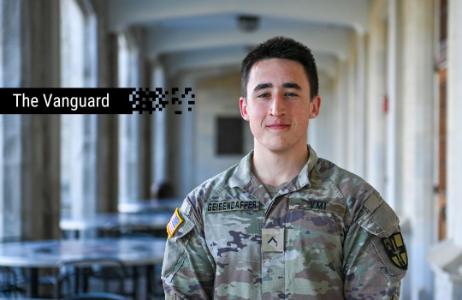 “I saw that to become that leader of value, I would have to go through challenges and struggle with myself,” he said.
His father was a VMI graduate. Growing up, he learned of his time at the Institute and said it was a big determining factor in attending versus enlisting.
It’s also the reason he became a corporal in the Old Corps. Geisendaffer said he wanted to be part of the team and serve as a leader, while taking accountability and ensuring everyone is responsible and doing their best.
"I take accountability for everybody that's in my squad, make sure that their uniform appearance is up to standard and make sure that people are doing what they're supposed to do in my company," he explained.
Originally entering the Institute on the cross country team, Geisendaffer switched to Ranger Challenge, which is described as an Army ROTC varsity sport. Teams form early in the semester and train nearly every morning of the week all the way up until the Sandhurst Military Skills Competition at the U.S. Military Academy (USMA) at West Point in mid-spring.
“I think the biggest factor is being able to work within a team. When I was in high school, I was doing sports throughout. I had a hard time expressing my ideas and my thoughts within a group, and hearing out other people's ideas,” he said. “But here, you have a job to do, so you must get along, and be able to communicate in a way other people understand. I think fundamentally, that's probably one of the biggest things for officers to have. I think it sets me up for success.”
The English major is forward thinking. He grew up reading and loved literature, especially classics like Charles Dickens’ novels. It was something he was naturally good at and was drawn to. He also saw the merit of choosing that major.
“I feel like having an English degree is going to give me the skills to be an effective communicator as an officer and as a team leader in general,” he said.
Maj. Adam Cody, assistant professor in the Department of English, Rhetoric, and Humanistic Studies, describes Geisendaffer as insightful and inventive, with a strong work ethic, precise attention to detail, and a productive rapport with peers.
During an in-class peer review workshop, Cody said Geisendaffer showed great promise in his leadership skills. He had a constructive and conscientious approach to peer mentorship, where he was patient and attentive with his classmates and his instructor, and his feedback on his peers’ writing reflected a diligent commitment to helping others improve their writing skills. 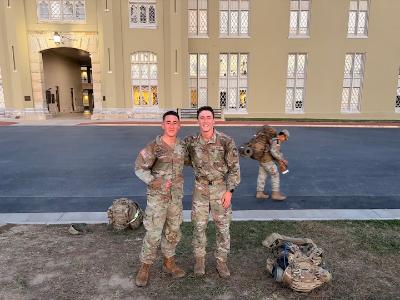
“Cadet Geisendaffer may consistently be relied upon for his keen understanding and thoughtful judgment,” Cody said. “In class, he displays a tendency to notice key details that other students overlook, and his critical and lateral thinking skills enable him to make connections between ideas and to integrate unfamiliar concepts into a coherent system of knowledge.”
Geisendaffer prefers not to procrastinate, which is a complete departure from his days in high school. Admitting that he was below average in high school, he didn’t take pride in his grades or think he was going to college. He decided he needed to make a change. Since coming to VMI, he’s disciplined and on the ball.
"I kind of blew a lot of the stuff off and went by doing the bare minimum,” he stated. “Then I got here, and I realized that there's more opportunities that come when you actually dedicate yourself to the grades and to these challenges. I found when I applied myself and I studied hard, I got the results that I wanted and the results that I deserved because of the changes that I made.
"I stayed on top of everything, especially during rat year, and I saw results, so I just kept sticking with it,” he continued. “I keep a detailed schedule of where I need to be, when I need to be there. I ask questions. I don't waste time.”
Lt. Col. Jochen Arndt, associate professor in the Department of History, has known Geisendaffer since he was a rat and enrolled in his world history course. He was impressed with his vigor for learning and his ability to earn high marks.
“Cadet Geisendaffer navigated the Rat Line with aplomb and performed in the top ten percent of my course, earning an ‘A’ for that semester — far above the average grade of a ‘C,’” he said. "He paid attention to detail, completed the assigned readings, came to class ready to participate, and took good notes. Given the amount of work required to perform well in this class, I am sure Cadet Geisendaffer had to work many late hours, especially in preparation for the course’s two research paper assignments and the 3-hour final exam, all of which he completed with superior grades.”
Arndt also noted that he uses his skills well by becoming a writing center consultant, where he’s able to help his peers become better writers and students. It was something that set him apart from his classmates.
“Cadet Geisendaffer struck me always as modest in spite of his superior performance. He went about his work in a professional manner, with seemingly no drama and no wasted energy,” he commented. “When he showed up at my door to discuss his paper assignments, for instance, I was pleasantly surprised to find that he came well prepared with completed drafts ready for my review. When I suggested changes, he listened carefully, asked good questions, and then implemented the required changes.”
Dr. Luke McNulty, adjunct professor in the Department of English, Rhetoric, and Humanistic Studies, said of his 57 students in a course where the current average grade is a C, Geisendaffer is one of 12 currently sitting at an A.
“I can rely upon Cadet Geisendaffer to have read and understood these difficult materials before our class meetings, and to share his thoughts as a leading participant in our group discussions,” he said. “He has served me as a valuable interlocutor, and he has served his peers as a model of clear, careful thinking and speaking. I hasten to add that he has also been a model of character in his willingness publicly to express and defend his ethical principles.”
Laura Peters Shapiro
Communications & Marketing
VIRGINIA MILITARY INSTITUTE