

.png)
Bott Designs Retractable Boat Anchor
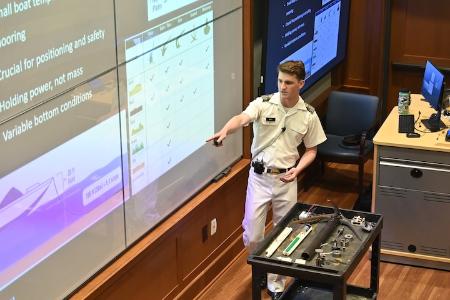
Connor Bott ’26 explains the different types of boat anchors and how they are used during his honors presentation in Scott Shipp Hall. –VMI Photo by Kelly Nye.
LEXINGTON, Va. April 14, 2026 — Connor Bott ’26, a mechanical engineering major at Virginia Military Institute, has designed a modern adaptation for an ancient devise with his honors senior thesis project, “Design and Analysis of an Electromechanical Marine Wreck Anchor.”
From the Eastern Shore town of Exmore, Virginia, Bott’s hobbies include fishing, boating, and scuba diving. Through these interests, he observed that small boat anchors, crucial for positioning the boat as well as for safety, often get stuck and have to be cut loose and abandoned, which inspired him to research better anchor designs.
He began his presentation with explaining how anchors work.
“There is a misconception that an anchor is just a big weight that you drop off the side of the boat and then the weight alone holds the boat in place. That’s not how they work. To properly operate them, you let out enough anchor line, then pull, allowing the anchor arms to burrow into the ground.” He added an important thing to consider when choosing an anchor, is the makeup of the seabed. “On the bottom could be sand, mud, rock, grass, clay, or a combination. If the boat is over a wreck, a reef, rocks, or trees, you might use a grappling hook style anchor, because instead of burrowing, it’s designed to hook onto something underwater.”
Bott explained challenges with grappling hook anchors.
“Anchor arms might hook under a rock, a log, or a hard piece of wreckage and get stuck. Unless you have someone who can put on scuba gear and dive down to wedge it free, you will have to cut your anchor line and leave the anchor. That is not a pleasing prospect, since some anchors can cost hundreds of dollars.”
To prevent loss of equipment and money, Bott wanted to construct an electromechanical anchor to drop over shipwrecks for divers who enjoy exploring wrecks like he does. He designed his anchor to be compact, have the look and feel like a regular grappling hook anchor, be intuitive to operate, use a physical and electrical tether, and realistically manufacturable. He envisioned a seatbelt-style release mechanism, so with a press of a button the anchor arms unfold, and the user can easily pull up the anchor.
After a lot of design and redesign work, much calculation regarding forces, friction, and water pressure, Bott’s design was ready to be tested. He engaged the expertise of engineering department lab technician Michael Cullen, and machinist Marco Floyd, who were instrumental in bringing the anchor to life.
“Building this thing was a fun process, because I would take my design down to our machinist, and he would look at it and say, ‘You’re crazy. We can’t make this on our equipment.’ So, we would sit down together, and he would come up with ideas on how we can break up this complex geometry to a bunch of little pieces, so that one piece became five different pieces that fit together like a little jigsaw puzzle.”
Bott concluded by sharing the next steps for his project are putting the electronics into the housing of the anchor, performing a leak test, and a final load test underwater. “I’m very happy with how far we’ve gotten, and I’m very excited to get this thing in the water and make sure it actually works like we hope.”
Col. Gerald “Jay” Sullivan, professor and head of the Department of Mechanical Engineering, served as Bott’s advisor on the project. Sullivan stated that given Bott’s hobbies—especially wreck diving—and all the mechanical maintenance that goes along with them, he wasn’t too surprised that he came up with this project.
“Connor is very good with his hands and highly analytical. He was able to bring together all these really great analytical skills that he has in mechanical engineering, with superior manufacturing skills, and intense creativity, to bring this project to fruition.”
Bott is the son of Charles Bott ’96. He is an alumnus of Norfolk Academy, and plans to pursue a graduate degree in marine or subsea engineering following graduation.
Marianne Hause
Communications & Marketing
VIRGINIA MILITARY INSTITUTE