

.png)
Bowen Explores Creative Writing Devices
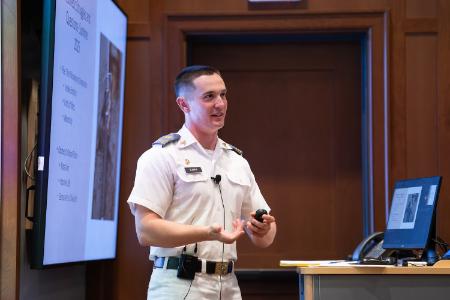
Ben Bowen ’26 explains the underlying driving principles of two of his favorite authors, Edgar Allen Poe and John Gardner, during his honors presentation in Scott Shipp Hall. –VMI Photo by H. Lockwood McLaughlin.
LEXINGTON, Va. April 10, 2026 — “Fiction does not spring into the world fully grown, like Athena. It is the process of writing and rewriting that makes a fiction original, if not profound.” —John Gardner.
Ben Bowen ’26, an English major at Virginia Military Institute, introduced his honors presentation by disclosing that it is not intended to prove an esthetic point or make a literary argument. Rather “Writing Happy Endings: Practice and Theory” is a work of literature. “I’m simply trying to write a story and tell you why I wrote it,” he stated.
Bowen confessed that because he has a deep love for reading, he did not think creative writing would be hard for him. “And then I started writing, and I found it to be extremely difficult and painful. I didn’t want to turn in any assignments. I wanted to keep revising.” To help overcome his struggles, he sought to discover why people read books, and the elements of a good story. He examined the underlying driving principles of two of his favorite authors: Edgar Allen Poe, who evoked emotion — especially melancholy — to grip the reader; and John Gardner, who believed good literature should have a moral aim and should have staying power and keep the reader engaged.
To illustrate the two writers differing points of view, Bowen used examples in his own creative writing. In both his short story, “Starbs Run,” and his novella, “Wild Turkey,” Bowen applies Poe’s principle of using strong emotional language, which he confessed was a great effort to write. He explained the purpose in writing the difficult scenes was to make the story real and not overly sentimental. “Nobody wants to read about a protagonist who is perfect. They want to read about a real person,” he explained. Bowen also wanted to genuinely represent trauma in his work, and make the reader question what they would do if placed in the character’s position.
Additionally, Bowen applies Gardner’s principle of using staying power. “No one is going to read a story for pleasure that doesn’t entertain them or isn’t interesting. So, I had to constantly think about using devices to keep the reader interested. I was constantly trying to use stories or little side tangents of action or of comedy to keep the reader entertained.”
Bowen concluded his presentation by sharing with the audience that his novella is not yet complete, and in keeping with the title of his honors presentation, he anticipates a happy ending. “There are a lot of good things coming, like hope and romance.”
Bowen’s advisor, Col. Polly Atwell, professor in the Department of English, Rhetoric, and Humanistic Studies, shared that what has impressed her most about Bowen is his enthusiasm and curiosity. “He’s one of the only students I’ve ever had who actually seeks out the work of his professors, not to get points, but just because he’s genuinely interested in what interests them. When I first read Ben’s fiction, I found he was a very talented and dedicated writer, and advising him on his novella has been incredibly fun and rewarding for me. His work ethic, his genuine desire to learn, his humor, and the connection he’s found between his writing and his personal ethics have all made him a true pleasure to work with.”
Bowen’s concentrations under his English major are writing and rhetoric, philosophy, and literary studies. He is the son of Floyd and Lisa Bowen of Forty Fort, Pennsylvania, and attended Wyoming Valley West High School. Following graduation, he will commission into the Marine Corps.
Marianne Hause
Communications & Marketing
VIRGINIA MILITARY INSTITUTE