Drone Detection Focus of Cadet Research
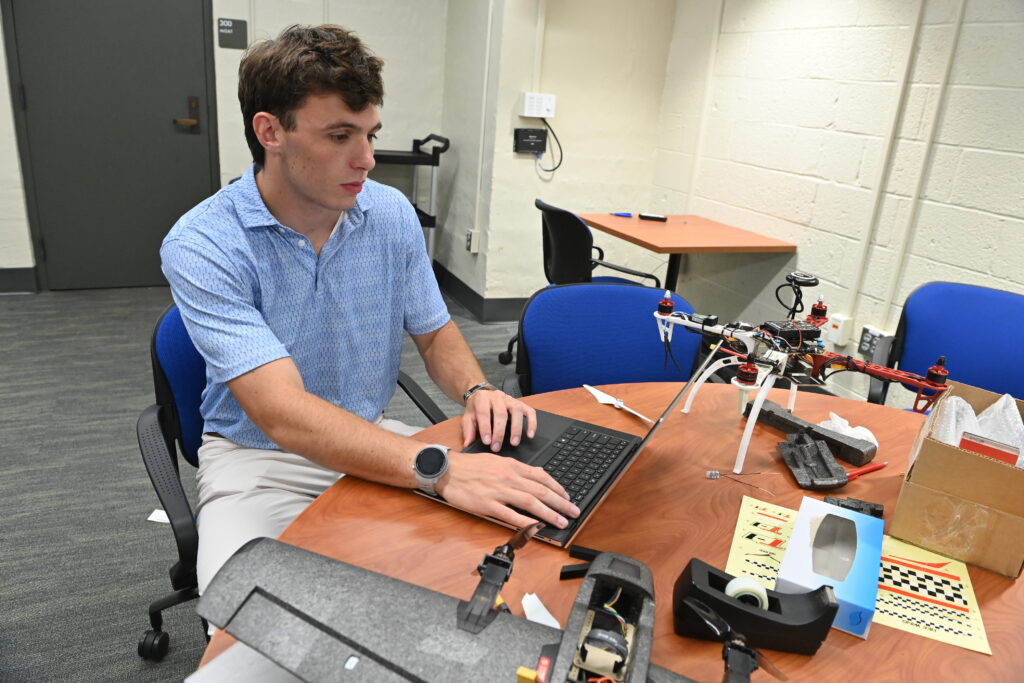
According to the website, Drone-Warfare, “2025 marked a watershed year in drone warfare, featuring history’s first drone battle between nuclear-armed nations, the first combat kill by naval drones against fighter jets, and the first underwater drone attack on a submarine.” Understanding the critical need for spotting approaching hostile drones, Rye Jackson ’28, an international studies major and computer science minor at Virginia Military Institute, is researching drone detection for his 12-week Summer Undergraduate Research Institute (SURI) project, “A Multi-Modal Survey of Drone Detection Methods: Acoustic, Visual, RF, and Fusion Approaches.”
Jackson was inspired to research drone detection while taking a business course during his rat year. “Drones are now widely used in both civilian and military settings, but their misuse near airports, critical infrastructure, and military bases creates serious security risks. By working with artificial intelligence, and computer coding, this is a real-world application I can explore after I graduate,” he explained.
He described how researchers have explored several drone sensing approaches, including acoustic detection, deep learning-based visual methods, radiofrequency (RF) monitoring, and multi-sensor fusion systems. He studied 15 recent literature reviews across those approaches, focusing on techniques that could realistically be deployed in noisy, cluttered, and contested environments. “Because when it’s raining you can’t see it, when there’s a thunderstorm you can’t hear it, and when both of those things are happening, RF is essentially the only way you can detect a drone. There are even stealth drones, which are very difficult to spot.” Jackson stated the best means of drone detection is not just one method, but a combination of all three: acoustical, visual and RF. He plans to continue his research for his capstone project during the next two academic years. He envisions building a small device equipped with a camera, microphone, and RF sensor. The device would be controlled by an app on his phone, and attached to a drone, which he would fly to detect other drones in the area.
Jackson’s faculty mentors for the project are Dr. Sherif Abdelhamid, assistant professor in the Department of Computer and Information Sciences (CIS) and team member of the Cyber Defense Lab, and Lt. Col. Doug Wainwright, CIS instructor and IT manager. In June, Sherif and Jackson attended a workshop on drone principles, hardware and flying, organized by VMI and Virginia Tech at Tech’s drone park.
Wainwright stated Jackson’s work is an excellent business prospect. “He can start a company with his idea, or sell the idea to a drone company, or to the Army or the Marines, who are now both working with drone strategy and drone detection and defense. It is extremely important and relevant.”
Jackson is a member of VMI’s track team, and leads the Fellowship of Christian Athletes for the team. He is a participant of the investment club and the drone club. He is from Daleville, Virginia, where he graduated from Lord Botetourt High School, and the son of Adam and Heather Jackson. His goal after graduation is to become an entrepreneur.