VMI Hosts 9th Annual Commonwealth Cyber Fusion Event
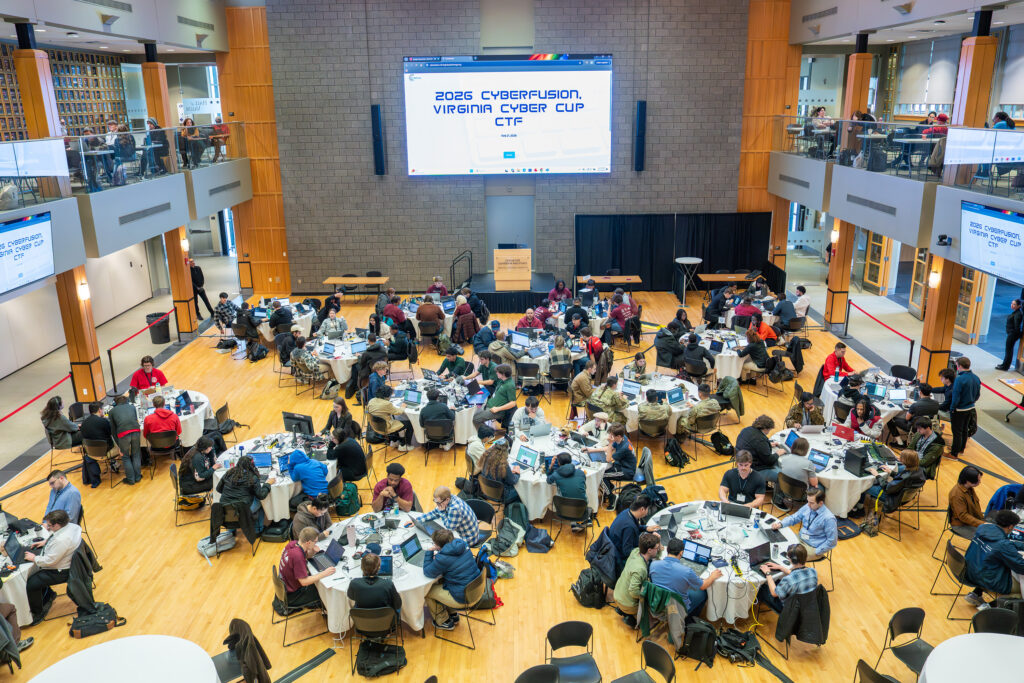
Virginia Military Institute hosted the 9th annual Commonwealth Cyber Fusion and Virginia Cyber Cup (VCC) Competition, a state-wide collegiate cyber security competition, February 20 and 21. The invitation-only event is for colleges that are National Security Agency (NSA) / Department of Homeland Security (DHS)-designated National Centers of Academic Excellence in Cyber Defense. It was organized by VMI’s Center for Leadership and Ethics (CLE) as part of its strategic engagement initiatives; and co-hosted by the Virginia Cyber Range, an initiative with a mission to enhance cybersecurity education for students in the commonwealth’s public high schools, colleges, and universities; and the Commonwealth Cyber Initiative (CCI), Virginia’s main access point for cybersecurity research, innovation, workforce development, and news.
VMI founded this cybersecurity event in 2017 at the suggestion of Bryce Bucklin ’17, a computer science major, who suggested the Commonwealth of Virginia create a statewide cybersecurity competition. United States Sen. Mark Warner served as honorary chairman.
Participating were 150 students with nearly 30 of their faculty advisors representing 19 colleges in Virginia: Danville Community College, ECPI University, George Mason University, Germanna Community College, James Madison University, Laurel Ridge Community College, Liberty University, Marymount University, Northern Virginia Community College, Old Dominion University, Radford University, Regent University, Tidewater Community College, University of Virginia, Virginia Commonwealth University, Virginia State University, Virginia Tech, VMI, and making their inaugural appearance, William & Mary.
Activities included a job fair, free professional headshots, a Tech Duels team debate competition, and a faculty/industry round table discussion hosted by representatives from CCI.
Col. David Gray, executive director of the CLE, served as master of ceremonies for the event. Brig. Gen. Robert W. Moreschi, dean of the faculty and deputy superintendent for academics, welcomed the participants to VMI. “You are here by invitation, which indicates that you are elite students in cybersecurity. Your career starts here with networking and honing your skills. The country needs you, the commonwealth needs you, and businesses need you. Make friends and enjoy your time here.” He then introduced the keynote speaker, Patrick McShea, executive director for cyber mission operations for CACI International Inc.Patrick McShea imparts the importance of soft skills during his keynote speech in Gillis Theater
McShea spoke on the importance of soft skills, such as teamwork, leadership, adaptability, problem-solving, communication, and creativity.
“Why do soft skills matter in a technical world? Employers want well-rounded people. I would take someone with a great attitude and the aptitude to grow into a role, over the smartest person in the room if I feel that the smartest person in the room is going to be a problem. Technical skills are a foundation, but they aren’t the only thing.”
McShea also stressed the importance of a well written and succinct resumé, and being true to oneself in discovering life’s calling. He ended by reminding the students that “Lifelong learning is not an option.”

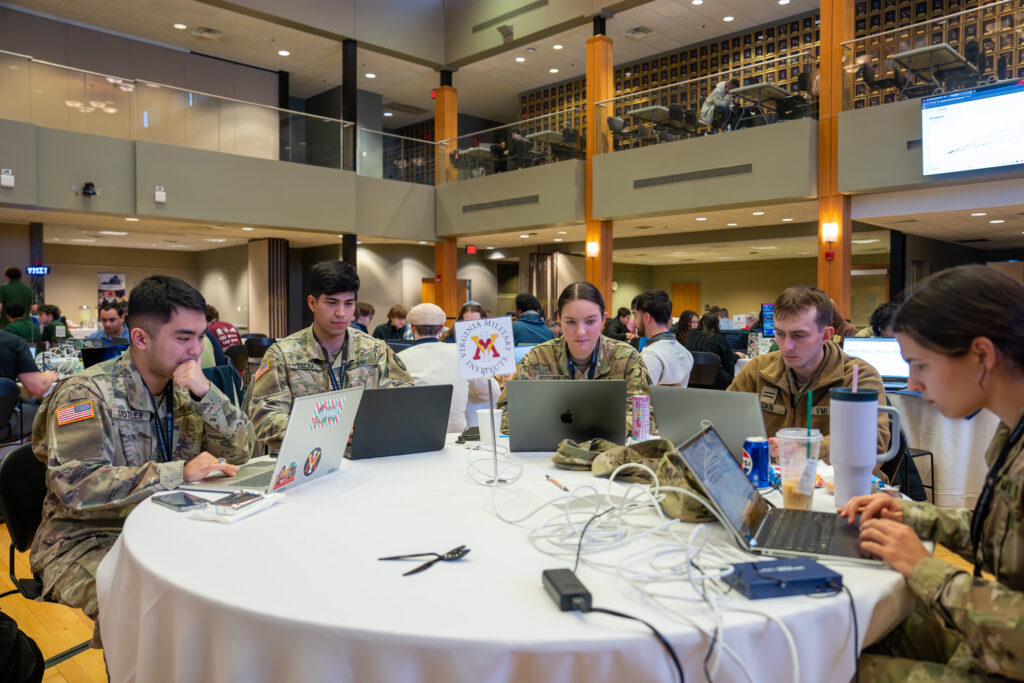
A highlight of the two days for the student participants was the VCC capture-the-flag competition, in which teams tackled problems in scenarios designed to model real-world computer security challenges across a range of categories including cryptography, network traffic analysis, and reverse engineering. George Mason University was the high scorer in the four-year college division. The University of Virginia finished second, and William & Mary came in third. For the community college division: Germanna Community College was the winner, followed by Danville Community College in second, and Tidewater Community College in third. VMI cadet competitors were Caroline Marini ’26, Sarah Fitzsimmons ’27, Isaac Gwin ’27, Santiago Rocha ’27, and John Stotler ’27. Their coach was Jacob Klein, software engineer in the Cyber Defense Laboratory. Klein stated the cadets did very well despite most of them being new to the competition.
“It was intimidating and nerve-racking, however they buckled down and put up a respectable score. They look forward to future opportunities to compete.”
Lt. Col. Kim Connolly, assistant director of programs and conference for the CLE, stated the collaborative event develops Virginia’s cybersecurity workforce. “Its unique design provides a well-rounded experience for the students, helping them develop both their technical and soft skills before they enter the workforce.”