

.png)
VMI’s Rogers Presents Thesis on Solitary Confinement
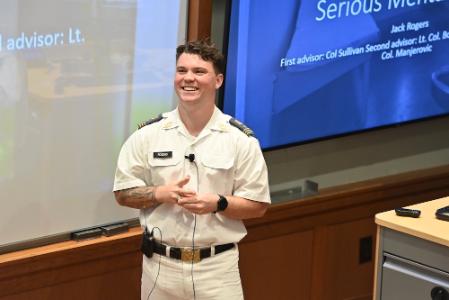
Jack Rogers ’26 presents his Rogers’ senior thesis, “Is Solitary Confinement Cruel and Unusual Punishment?” April 3 in Scott Shipp Hall as part of VMI Honors Week.--VMI Photo by Kelly Nye.
LEXINGTON, Va. April 7, 2026 — Jack Rogers ’26, a psychology major at Virginia Military Institute, will be taking his interests developed through his major with him as he heads to Mercer University School of Law after graduation. There are a number of elements related to mind and behavior that can come into play in the legal realm, including the practice and effects of solitary confinement, leading to Rogers’ senior thesis, “Is Solitary Confinement Cruel and Unusual Punishment?” which he presented April 3 as part of VMI Honors Week.
He worked closely with his advisor, Col. Glenn Sullivan, professor in the Department of Psychology, on his research. Analyzing articles and legal cases, he learned a lot about what solitary confinement looks like and how it can greatly impact one’s well-being, especially those already facing serious mental illness.
In defining solitary confinement, he reminded his audience not only of the small space, often the size of a parking space with no social interaction, but also of the unnatural light that could remain on for up to 24 hours a day, which can greatly impact sleep and sanity. Originally designed in the late 18th century to be humane and provoke reflection and repentance, Rogers’ research shows the practice of solitary confinement today often lacks oversight and pushes the legal boundaries of medical neglect. One key detail Rogers noted was that prisoners are not normally told the length of time they’d be placed in solitary confinement, basically another “version of torture,” he explained.
Many countries and groups have focused on solitary confinement reform, aiming to lessen the cruelty inflicted on inmates. While countries like Norway, Germany, and Turkey have taken strides in this, the United States is behind. Countless bills have been proposed, but rarely move forward. One such bill stated that the prison system has lost its vision to reform an individual. While Rogers acknowledges that some in decision-making positions identify solitary confinement as something that needs to be reviewed, he believes many of those decision makers only focus on issues that impact them.
While Rogers determines he’s not against solitary confinement as a practice, he does conclude in this thesis that prolonged solitary confinement of those with serious mental illness is cruel and unusual punishment.
“Jack Rogers’ thesis sits right at the fault line between psychology and the Constitution. He shows that what prisons call ‘management’ often exacerbates the symptoms of serious mental illness,” shared Sullivan. “What’s especially impressive is that he doesn’t just summarize the law—he anticipates it. His analysis of past Supreme Court cases suggests that the Court is slowly moving toward recognizing prolonged and indefinite solitary confinement of the seriously mentally ill as incompatible with the Eighth Amendment. He makes a compelling case that solitary confinement has become a kind of shadow on the mental health system—one that isolates rather than treats—and that the legal framework is struggling to catch up with what psychologists have known for decades.”
Rogers, an NCAA lacrosse player, came to VMI from Suwanee, Georgia, after graduating from North Gwinnett High School. His parents, John and Rebecca, attended his presentation and note that he has thrived in the VMI environment. Once Rogers completes law school, he hopes to go into the U.S. Army JAG Corps.
Lt. Col. Michelle T. Elwood
Communications & Marketing
VIRGINIA MILITARY INSTITUTE