

.png)
Vijayan Studies Military Logistics
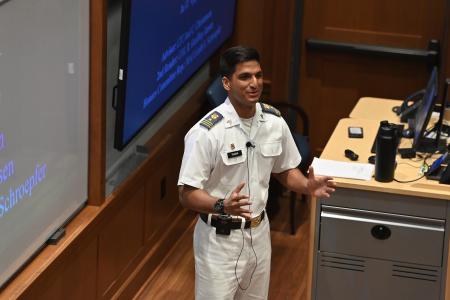
Jai Vijayan ’26 discusses failures and successes of military logistics during his honors project presentation. –VMI Photo by Kelly Nye.
LEXINGTON, Va. April 2, 2026 — Jai Vijayan ’26, an economics and business major at Virginia Military Institute, researched military logistics during World War II for his honors project, “Move and Maintain: American Last-Mile Logistics in the Solomon Islands Campaign, 1942-1944.”
Vijayan, who will commission into the U.S. Army as a logistics officer after he graduates in May, explained the definition of military logistics as the practice of moving armies, including transporting military forces, keeping them supplied, planning and road building, and the administrative work carrying out those activities. The focus of his thesis was the final, crucial step of the supply chain; moving supplies from friendly, established bases to contested front lines, known as “the last mile,” specifically, to the Solomon Islands following the Japanese attacks on Pearl Harbor, Southeast Asia, and the South Pacific in 1941.
The Solomon Islands are a chain of islands in the South Pacific, northeast of Australia, and include Guadalcanal, New Georgia, and Bougainville, all locations of significant WWII battles. The Japanese attacks threatened the American supply lines to Australia and New Zealand. For that reason, the Solomons became decisive in ensuring those supply lines remained open and the Japanese advance was halted.
“Guadalcanal is widely regarded as an allied tactical victory, but a logistics disaster. Initially, isolated Marines were forced to subsist on two rations per day and captured Japanese rice. Aircraft sat idle because there was not enough fuel. Gradually, the allied forces were able to sustain their offenses in New Georgia and Bougainville, thanks to the idea of ‘island hopping,’ taking control of the islands one by one, and turning them into support bases,” explained Vijayan.
He went on to report that most historians agree that the U.S. logistics system was a big factor in winning the war for the allies, but they differ on what part of that logistics system was significant. To that end, Vijayan sought to answer the research question, “How and why did last-mile logistics improve past the crises at Guadalcanal?”
To answer his question, Vijayan examined the various logistics methods the military incorporated during the three operations to secure the islands. He discovered the successes, the failures, and how the methods progressively improved throughout the “island hopping.” The first, the Battle of Guadalcanal, codenamed Operation Watchtower, took place from August 1942 to February 1943; followed by the invasion of the New Georgia, codenamed Operation Toenails, from June to October 1943; then the Battle of Bougainville, codenamed Operation Dipper, from November 1943 to May 1944.
He concluded by confirming that circumstances improved with each new operation due to improved access to military facilities, shortened supply lines, absence of time pressure, and diminished enemy capabilities. “It’s easy to understand why the last model was much more effective. Improvements helped the allied forces avoid the crises that took place on Guadalcanal. There was better unloading coordination, supply lines were deliberately planned and proactively built inland, and supply dumps were deliberately placed for a more effective system. All these decisions improved last-mile logistics. There was definitely a learning curve that moved past the mistakes at Guadalcanal,” closed Vijayan.
Vijayan’s advisor, Lt. Col. Joel Christenson ’99, associate professor in the Department of History and director of the John A. Adams ’71 Center for Military History & Strategic Analysis, said it was a pleasure working with Vijayan. “Jai’s project is thoughtful, innovative, timely, and applicable, and I think his investigation into logistics and the Solomon Islands campaign in the Second World War proves that there is new information even in the most studied of conflicts.”
Vijayan is minoring in military history and Chinese. He is an alumnus of the Canadian International School in Singapore and the son of Bharat Vijayan and Archana Velukutty of Tully, New York.
Marianne Hause
Communications & Marketing
VIRGINIA MILITARY INSTITUTE